
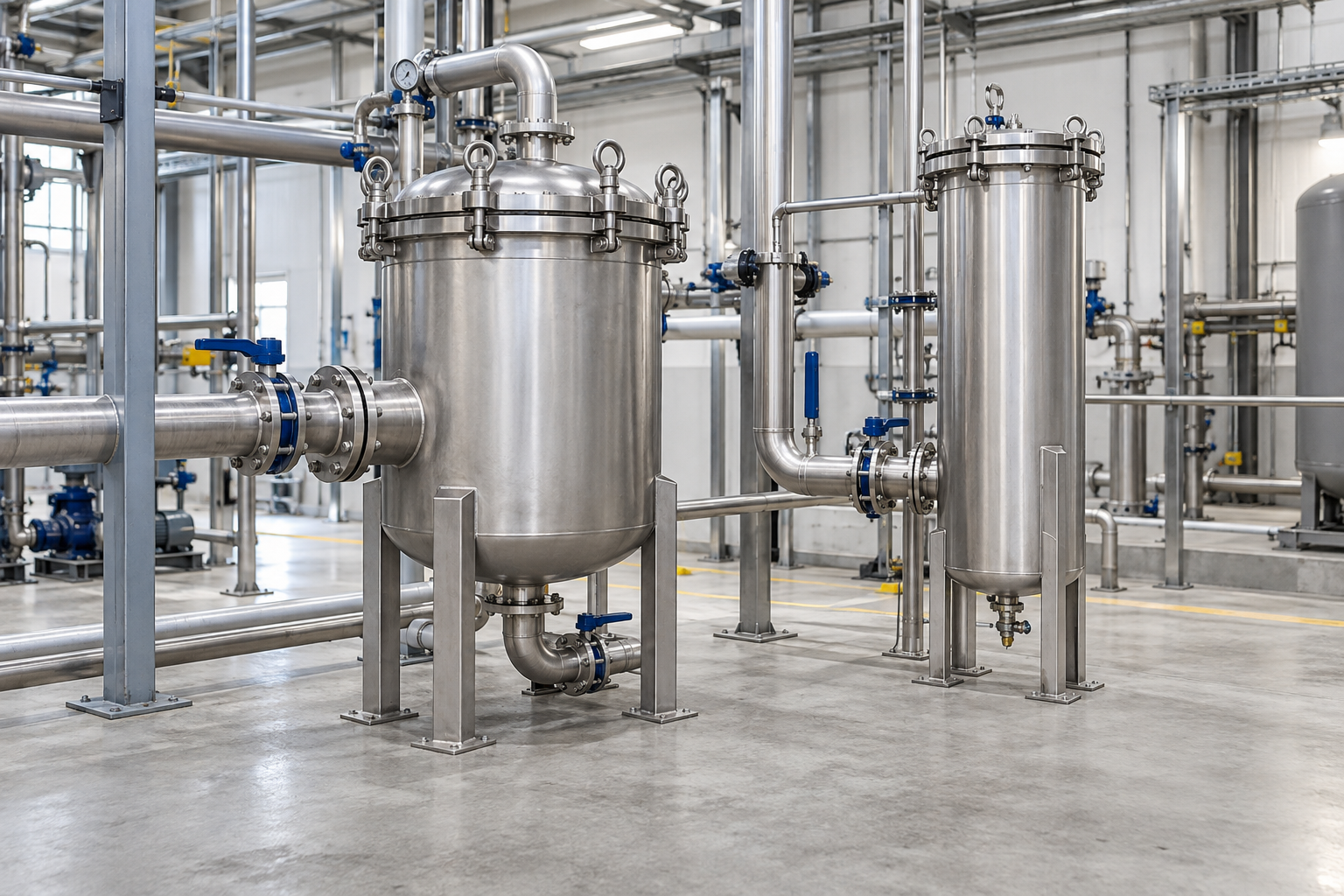
Before commissioning a bag filter, confirm the flow direction, support, service clearance, isolation and drain arrangements, and the operating conditions against the equipment documents. Matching the pipe connections is only one part of installation. Confirming access and the handover information before the system starts can help the operations team maintain the filter safely and consistently.
Check the equipment and installation position
Compare the nameplate, packing documents and layout drawing to confirm the housing model, connections, flow direction, rated conditions and supplied accessories. Verify that the base or supports and connected piping follow the project design. Do not pull pipework into alignment by placing unintended loads on the filter nozzles; have the responsible design or installation engineer confirm support and allowable loads.
Plan the service envelope before fixing the equipment in place. Check cover-opening direction, the height required to remove a bag or cartridge, lifting access, tool clearance and the operator’s working position. Nearby walls, valves, cable trays and other pipes can block routine inspection. Long elements or multi-bag designs may need additional extraction clearance above or beside the housing.
Review pipework, valves and drainage
Confirm the inlet, outlet and process flow direction against the drawing and housing markings. Check that isolation valves, any specified bypass, pressure measurement points, vents and drains match the process design. Drain discharge must go to a location approved for the process liquid and site waste rules; do not route an unknown or hazardous liquid to a floor drain or stormwater system.
For hot, pressurized or hazardous service, ask the responsible engineering and safety personnel to confirm the required protective measures and operating boundaries. The filter’s operating pressure, temperature and accessories must come from the equipment documentation and project design. Do not apply limits from another model.
| Handover item | Confirm before operation |
|---|---|
| Equipment identity | Model, serial or nameplate details and supplied documents |
| Process arrangement | Flow direction, inlet/outlet, valves and measurement points |
| Service access | Cover clearance, bag or cartridge removal path and lifting needs |
| Drain and vent | Approved discharge location and site operating procedure |
| Consumables | Bag or cartridge model, dimensions, rating and spare information |
| Operating boundaries | Project and manufacturer pressure, temperature and flow basis |
| Records and contacts | Installation check, service documents and responsible personnel |
Inspect and commission using the project documents
After installation, perform piping, sealing and start-up checks as directed by the equipment manual and site procedure. During an authorized start-up, bring the system into operation according to the project sequence and watch for leakage, abnormal movement, flow direction and instrument readings. Use acceptance criteria defined by the project or manufacturer; do not borrow numerical limits from a different filter.
Record the initial conditions and any observations. Keep the manual, installation notes, layout and site photographs with the equipment record so maintenance staff can understand its configuration and limits later.
Bag and precision filter products
Shenzhen Guangxiangyu Technology Co., Ltd. supplies single-bag, multi-bag and quick-opening bag filter housings, precision filter housings and compatible consumables. For a selection inquiry, provide the liquid, flow, pressure and temperature conditions, piping layout and the available service space. Site installation and piping design should follow the project documents and be handled by the responsible qualified personnel.
See our bag filter housings and precision filters. Contact Liu Nan, Sales Manager, at LiuNan2553@gmail.com.
Technical reference
Eaton Bag Filter Housing Installation, Operation and Maintenance Manual. The manual covers specific housing designs; follow the documentation and project requirements for the equipment installed at your site.