
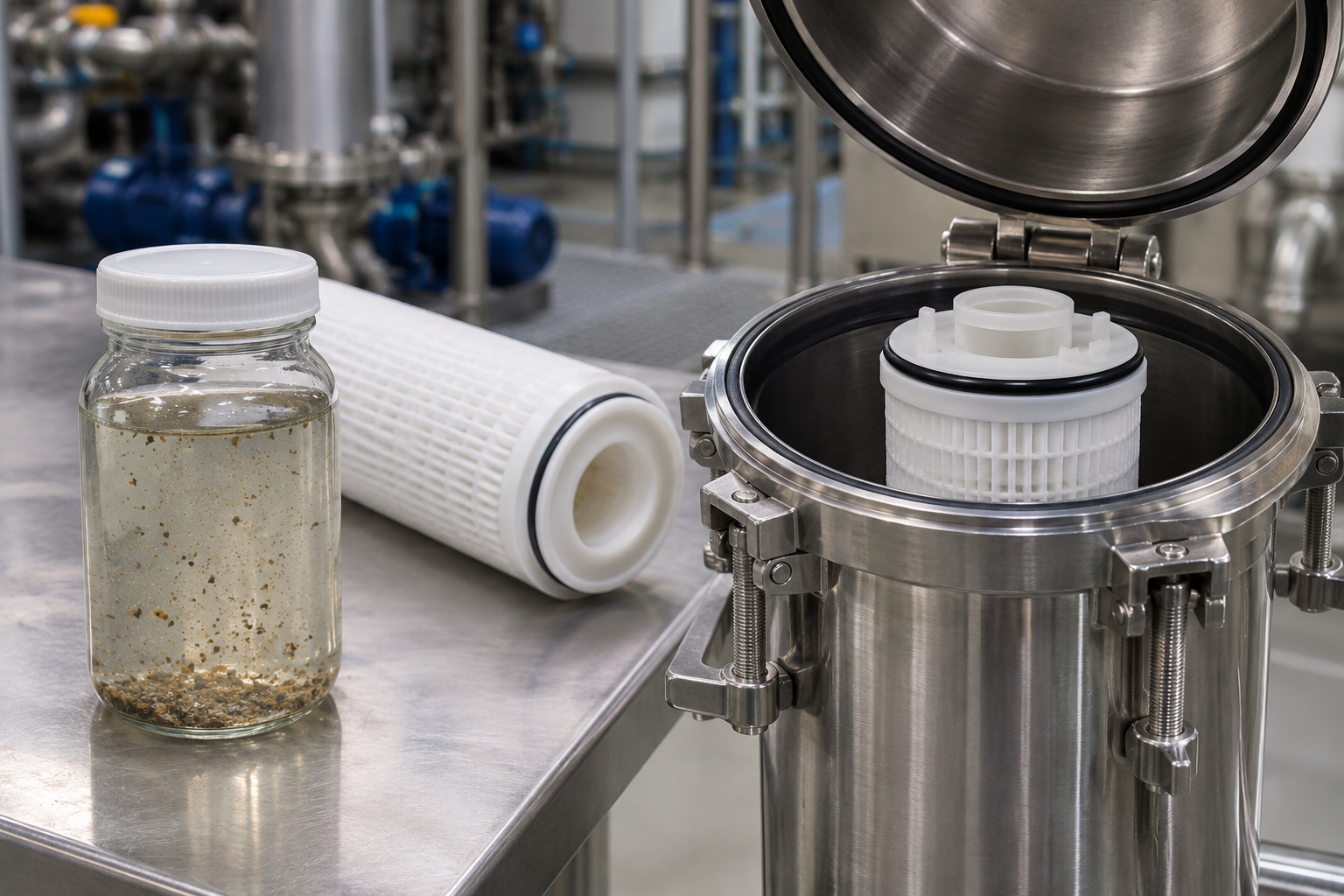
After replacing a cartridge, check the model, length, connections, orientation and seal placement against the equipment instructions. Restore operation and record the initial condition under the site procedure. If there is bypass, leakage, an unusual pressure drop or a change in flow, stop and investigate under the approved process. Do not force pressure higher or open a pressurised housing to correct an installation.
Verify the cartridge and assembly
Compare the cartridge with the housing model and purchase record. Check that the end caps, seals, locating features and support parts are intact. Seat and secure the cartridge as directed by the manufacturer. Do not compensate for a length mismatch by adding improvised spacers, cutting the cartridge or forcing it into place. When replacing multiple cartridges, record each model, batch and installed position.
Filter designs use different end connections and sealing arrangements, so there is no universal installation motion or torque. Follow the manual for the exact housing and cartridge. Before maintenance, isolate and depressurise the assembly as required by its instructions and the site's safety procedure.
Record the baseline after returning to service
Under the site procedure, check the housing closure, valve positions and pipe connections before gradually returning the system to operation. Record the time, flow, inlet and outlet pressure or other equipment readings, liquid temperature and any leakage. Keep sampling methods consistent. Readings taken at different flow rates, pump states or instrument points should not be compared as if conditions were the same.
Once operation is stable, use the flow, pressure or differential-pressure readings and filtrate condition as the initial baseline after this change. If results differ significantly from previous records, pause the evaluation and check installation, cartridge batch and process changes. An authorised maintenance person should handle any abnormal condition using the equipment documentation.
Compare like with like
Where possible, keep the production recipe, flow and sampling method consistent before and after replacement. This makes it easier to identify whether a change could be related to installation or the cartridge. If a seal is reused, check the product requirements and its condition; replace it as specified if it is twisted, cracked or hardened. Do not apply an unapproved lubricant or overtighten a closure in a way that could damage the cartridge end or housing.
Normal flow alone does not prove that the cartridge is correctly sealed or meeting the filtration target. Check the model, seal, operating readings and any required downstream measurement together. Never inspect or retighten a cartridge by opening the housing under pressure; follow the isolation and depressurisation procedure.
Cartridge and filter housing inquiries
Shenzhen Guangxiangyu Technology Co., Ltd., established in 2009 in Longgang District, Shenzhen, supplies precision filter housings, cartridges and bag filtration equipment. For a compatibility inquiry, share the housing nameplate, photos of the cartridge ends, model and operating records with Liu Nan, Sales Manager, at LiuNan2553@gmail.com. Installation and maintenance must follow the equipment manual and the site's safety requirements.
See our precision filters, filter cartridges, or contact page.
Technical reference
- Parker, Balston 8L, H and K Series Filter Technical Information. The instructions describe removing the specified assembly from service and depressurising it before changing a filter; follow the manual for the installed equipment.