
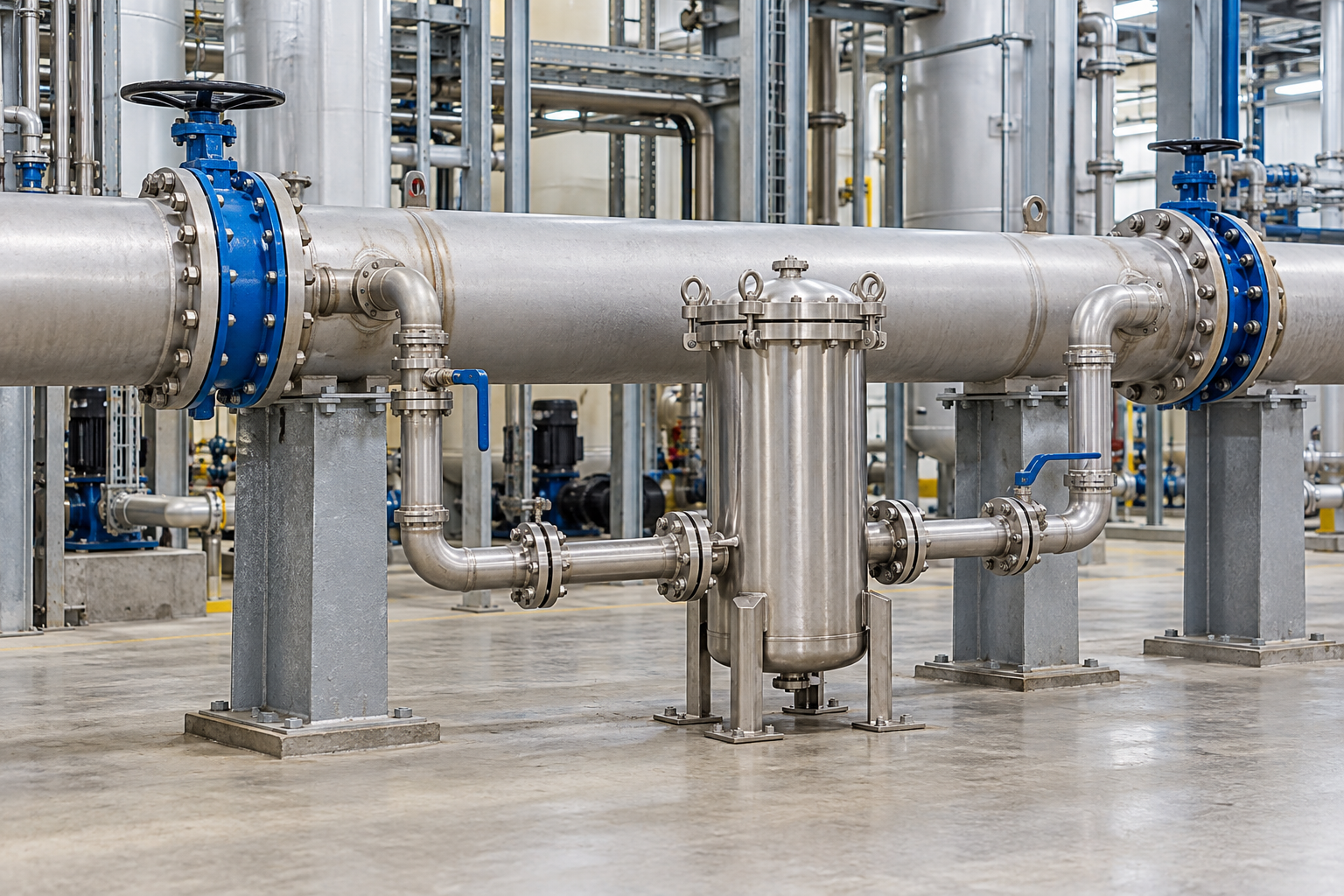
A side-stream filter treats a branch of circulating cooling water. Its flow, filtration method and evaluation criteria should be selected for a defined system problem. Do not apply one fixed percentage of total circulation flow to every cooling tower or assume that particle filtration alone will correct all water-quality problems.
Start by identifying the suspended material to control, where it enters the system and which equipment or operating issue is affected. The U.S. Department of Energy notes that cooling tower filtration needs vary with tower design, local conditions and water quality, and that particle size distribution and total suspended solids (TSS) tests can help select an appropriate technology.
Define the objective and the water problem
Clarify whether the goal is to reduce suspended solids, limit sediment accumulation in a basin, or protect a particular branch or heat exchanger. Identify the relevant water-quality indicators, suspected particle sources and sampling locations before selecting equipment. Make-up water, airborne debris, corrosion products, deposits and changes in operating load can all affect the system record.
Particle filtration is not a complete cooling-water treatment program. It does not remove dissolved salts or, by itself, establish control of hardness, scale chemistry, corrosion or microbiological activity. If those are the main concerns, involve the responsible water-treatment designer and use the appropriate water analysis and process controls.
Prepare site and process information
Gather the following before asking for a proposal:
- Cooling water analysis, TSS data and particle size information where available.
- Main contaminants, likely sources and the equipment showing fouling or deposits.
- System volume, normal and peak circulation flow, make-up and blowdown information.
- Available branch flow, pressure and temperature at the proposed connection points.
- Existing pumps, valves, pipe sizes, control sequence and return location.
- Required operating schedule, maintenance access, cleaning or backwash disposal route.
- Existing filter data, including media, pressure trend, service frequency and observations.
If an existing side-stream filter is installed, provide its model and actual branch flow where measured. Clarify whether the cooling loop operates continuously and what interruption is acceptable during maintenance. A nominal equipment flow alone does not confirm the amount of water that will be treated in the installed branch.
Size the side stream to the actual system
The appropriate branch flow depends on the system volume, solids characteristics, target particles, filtration technology and the desired rate of removal. The DOE guidance explains that sizing depends on both flow and filtration efficiency. Ask the system designer or filter supplier to document the basis for the proposed flow and media, including relevant operating assumptions. A rule of thumb for one cooling-tower setup should not be treated as a universal design requirement.
Confirm that the proposed take-off and return points fit the hydraulic design and do not compromise the main loop. Review pump duty, available pressure, valve arrangement and control logic with the engineer responsible for the system. Allow space for the equipment and a practical way to remove collected solids or dispose of backwash water if the selected technology produces it.
Set a trial and evaluation method
Before a trial, agree on the observation period, sampling points, test methods and responsible person. Record branch flow, filter pressure difference, maintenance events and main-loop conditions. Compare samples collected in the same way and note changes to make-up water, blowdown, chemical treatment or production load.
If the results do not meet the objective, first check whether the branch operates at the intended conditions and whether the selected medium is appropriate for the particles measured. Then review the overall system with the cooling-water designer. A single sample or a clear-looking basin does not establish long-term filtration performance.
Filtration products and inquiries
Shenzhen Guangxiangyu Technology Co., Ltd. supplies bag filter housings, precision filters and compatible filter media for industrial liquid filtration. For a side-stream filtration inquiry, share the water analysis, target solids, system volume, branch flow and pressure, pipe arrangement and maintenance conditions. The complete cooling-water treatment design and water-quality targets should be confirmed by the responsible engineering and water-treatment parties.
See our bag filter housings and precision filters. Contact Liu Nan, Sales Manager, at LiuNan2553@gmail.com.
Technical reference
U.S. Department of Energy: Side-Stream Filtration for Cooling Towers. It explains why cooling tower design, local conditions, water quality and particle tests matter when selecting a filtration approach.