
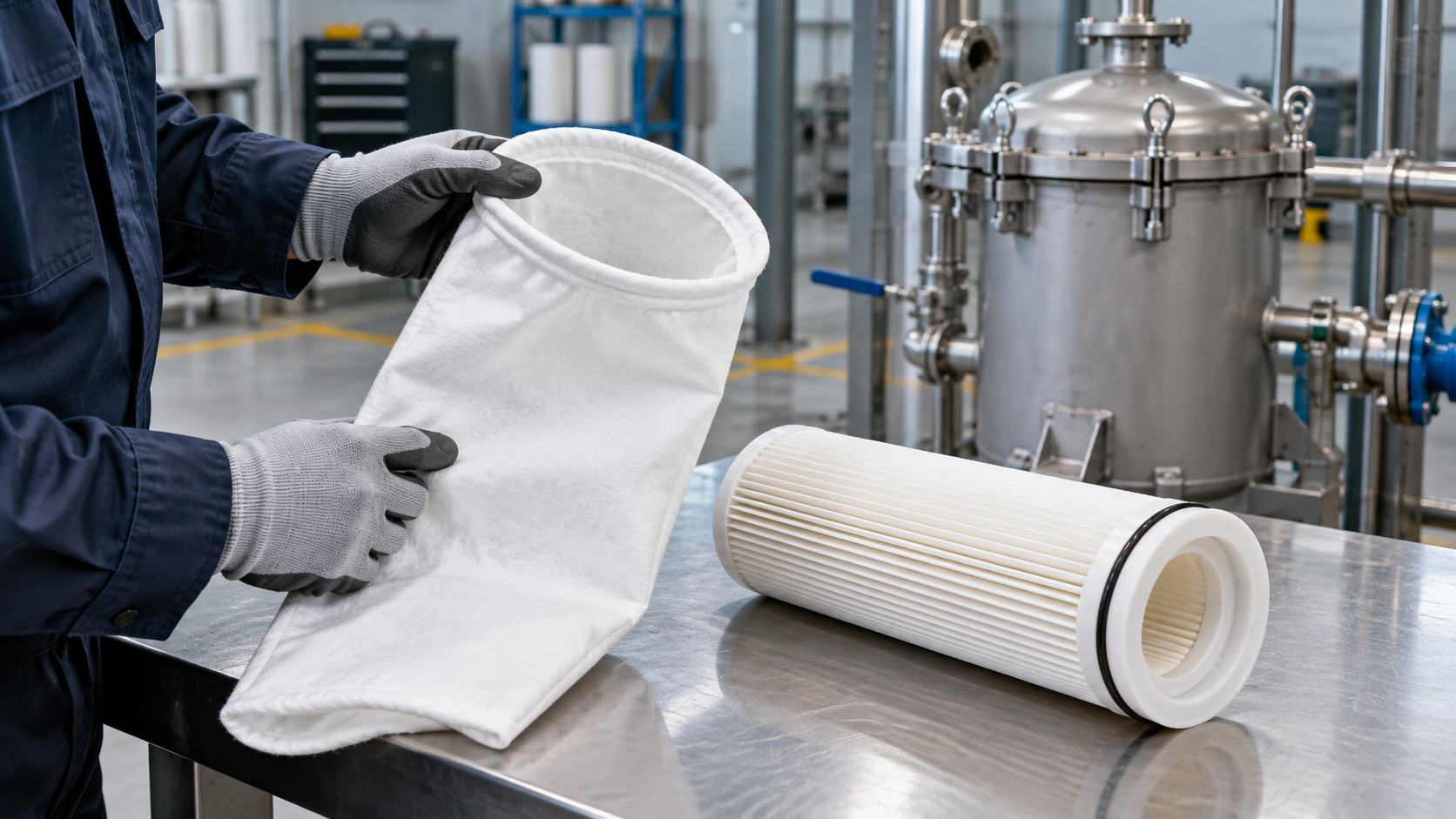
Choosing a bag or cartridge for electroplating bath filtration requires more information than the words "plating solution." The plating process, bath formulation, temperature, contaminant sources and circulation arrangement all affect the choice of filter media, wetted materials and seals. Verify the relevant materials against the actual conditions rather than applying a general recommendation to every bath.
Particles in a plating bath may come from workpieces, anode materials, piping or the production environment. Changes in the process liquid itself can also affect observations. Agree on the filtration objective with the process team first: retaining visible particles, reducing suspended matter in the circulating liquid or meeting a defined quality test. Different objectives require different selection and verification methods.
1. Five details to confirm before selecting the media
| Information | Details to provide |
|---|---|
| Bath type and composition | Process name, known composition ranges, additives and cleaning agents |
| Temperature and operating time | Normal and peak temperatures, and whether circulation is continuous or intermittent |
| Particle characteristics | Contaminant photos, sample observations or test results, including settling or flocculation behavior |
| Flow and circulation arrangement | Normal and peak flow, pump and piping information, and equipment location |
| Performance acceptance | Sampling points, test method and permitted shutdown or maintenance procedures |
If the formulation is confidential, the process team can provide the information needed to assess material compatibility and agree on confidentiality arrangements with the supplier. Describing a bath only as acidic, alkaline or by a shortened process name is usually insufficient to confirm long-term material suitability.
2. Comparing bag and cartridge arrangements
A filter bag works with a supporting basket and may suit an arrangement where the bag needs to be removed for inspection or replacement. A cartridge arrangement requires confirmation of cartridge length, end connections, quantity, seals and housing configuration.
For either option, check the filtration rating definition, effective filtration area and compatibility with the liquid. Where particle loading varies, use trial records to compare samples before and after filtration, operating time and maintenance frequency. Avoid reaching a conclusion from one observation alone.
If particles increase at the outlet, media becomes damaged, differential pressure changes unexpectedly or the liquid appearance changes, review several possible causes. Check for bath process changes, an unsuitable media choice, incorrect bag collar or cartridge seating, and flow outside the equipment's operating conditions. A finer replacement media may not address the underlying cause.
3. Keep records during trials and media changes
If the process permits a limited trial, first record the existing bag or cartridge model, bath temperature, circulation flow, installation date and samples before and after filtration.
After fitting candidate media, keep production conditions as similar as possible before comparing performance. Record bath additions, tank cleaning, filtration pump adjustments and production formulation changes during the trial. These changes should not all be attributed to the filter media.
A useful record connects the media identification with the actual operating conditions and sample observations. It allows the process team and supplier to review what changed, rather than comparing replacement dates without the conditions behind them.
4. Respond to signs of material or sealing problems
If media swells, becomes brittle, separates into layers, sheds fibers or develops a sealing problem, stop the trial and follow the site's process and safety procedures. Retain the product identification and sample information, and ask the supplier to verify the material data.
Such conditions may affect the bath and product quality. Continuing to run the filter for longer simply to observe the problem is not an appropriate substitute for checking the cause.
5. Related Guangxiangyu Tech products
Shenzhen Guangxiangyu Technology Co., Ltd. was established in 2009 and is based in Longgang District, Shenzhen. We supply industrial liquid filtration equipment and water treatment cartridges.
Our range includes stainless steel bag filter housings, filter bags, cartridge filter housings, PP melt-blown cartridges and plating filter cartridges. We can discuss specifications and custom requirements using the operating information provided.
This guide does not replace plating process design or establish material compatibility for an unverified bath. Confirm the complete media construction, wetted parts and operating conditions for the actual application.
See our bag filter housings, filter bag range and filter cartridges. For a selection discussion, prepare bath properties, temperature, flow, target particles, equipment and media photos, and maintenance records. Contact Liu Nan, Sales Manager at LiuNan2553@gmail.com.
6. Frequently asked questions
Which micron rating should be used for electroplating bath filtration? Confirm the rating using the plating process, particles, quality requirements and media test results. One fixed micron rating should not be applied to all plating baths.
Can a standard PP cartridge be used? Suitability depends on the materials in the complete cartridge, bath composition, concentration and temperature. Request compatibility information and validate the choice against the process requirements before use.