
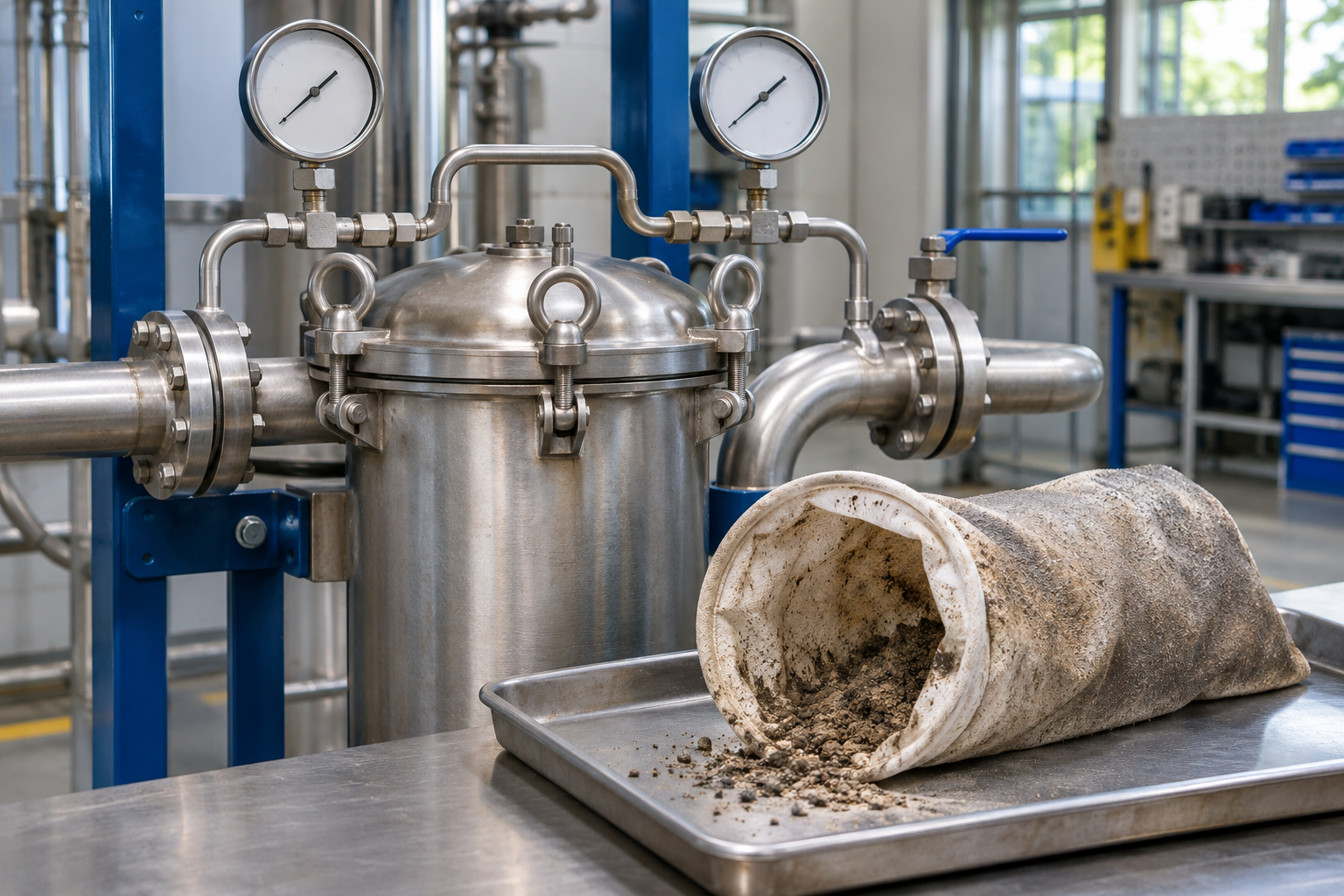
A filter bag's dirt-holding capacity is not a fixed service-life figure that applies to every process. The time between changes depends on the concentration and nature of the particles, flow rate, media construction, effective area, sealing and filtration objective. When comparing bags, check the data for the specific product and compare it with site records instead of estimating a change interval from how much debris a bag appears to hold.
Record the conditions behind each change
For each replacement, log the installation date, operating hours, processed volume, flow, process-liquid temperature, pressure or differential-pressure readings, captured material and reason for changing the bag. Note production batches, upstream cleaning and changes in incoming liquid. A higher particle load can shorten a change interval, while different inspection habits between shifts can make records difficult to compare.
Compare bags under comparable conditions
For candidate bags, compare construction, material, filtration rating and how that rating is defined, effective area and performance in the process liquid. Check that the bag collar and housing seal match; bypass around a poorly seated bag can make apparent filtration performance misleading. If a product sheet gives capacity or test data, review the test conditions and confirm how closely they represent the actual process.
Any change to the filtration rating should also be reviewed against downstream quality requirements and the effect on flow resistance. Eaton's filtration literature describes different bag constructions and capacity characteristics for particular products, but product-specific data should not be treated as a guaranteed service interval for another liquid or operating condition.
Classify why each bag was changed
Separate changes caused by rising differential pressure or reduced flow from scheduled maintenance, damage, sealing problems, product-batch changes and production shutdowns. Note where particles accumulated and the condition of the bag when it was removed. Several records from the same product under similar conditions are more useful for identifying a trend than a single visual estimate of how full a bag looked.
When comparing different models, track effective area, collar fit, rating definition, liquid conditions and operating flow alongside the change interval. Otherwise, a difference in the housing or process may be mistaken for a difference in dirt-holding capacity.
Build a change interval from field records
Record cumulative operating hours, processed volume, inlet particle conditions, flow and pressure readings each time a bag is changed. Comparing elapsed days alone can be misleading when production volume or incoming liquid differs. The distribution of retained material can also help distinguish a generally high solids load from localised loading. Use these observations to discuss whether media selection, pretreatment or maintenance frequency needs review.
Establish a baseline over repeated operating cycles, then have process, maintenance and supply teams review the results together. A single trial should not be treated as a long-term service-life guarantee.
Bag filter and media inquiries
Shenzhen Guangxiangyu Technology Co., Ltd., established in 2009 in Longgang District, Shenzhen, supplies bag filter housings and compatible filter bags, along with other industrial liquid filtration equipment and water-treatment filter elements. To discuss bag selection or replacement intervals, share the process liquid, flow, bag model, operating hours and change-out photos with Liu Nan, Sales Manager, at LiuNan2553@gmail.com. Actual service life must be confirmed from operating records for the application.
See our bag filter housings, filter bags, or contact page.
Technical reference
- Eaton, Criteria to Consider When Choosing Bag Filtration Technology. The article discusses bag-filter design choices and capacity in relation to process conditions; the data for a selected product should be checked for the intended application.