
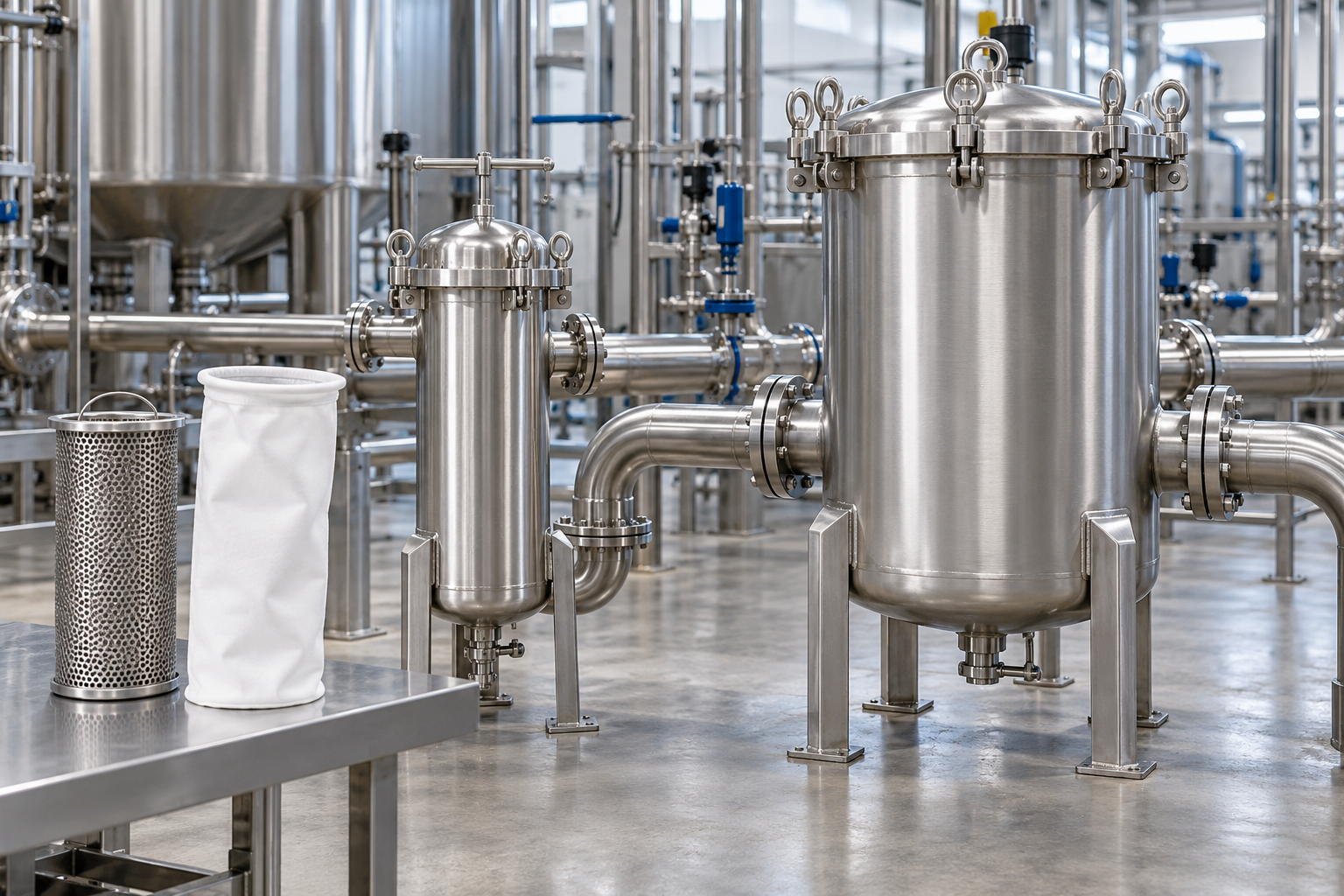
A micron number on a filter bag does not, by itself, tell you how much of a particular particle size the bag will retain. Before comparing or replacing bags, confirm whether the rating is nominal or absolute, how the supplier defines it, what test method supports it, and whether the data apply to the specific bag construction and process liquid.
What a micron rating does and does not tell you
“Nominal” and “absolute” are not universally interchangeable terms. Their meanings and the efficiency associated with a stated micron size can vary by manufacturer and product. Donaldson, for example, publishes its own definitions for nominal and absolute ratings and explains the assumptions behind laboratory retention data. That is a useful reason to check the supplier’s documentation instead of treating the label as a common industry guarantee.
Ask for the particle size used in the test, the test method, the stated capture efficiency, and the exact bag model to which the results apply. Confirm whether the rating is supported by product data or a batch document. A micron value without its test basis is not enough to compare two different bags on performance.
Describe the filtration objective before choosing a rating
“Make the liquid cleaner” is too broad for a reliable selection. Describe the suspected contaminant and where it enters the process, the downstream equipment or product that needs protection, and the particle-control objective. If available, include a water or liquid analysis, photographs of collected material, and the operating history of the current bag.
Also provide normal and peak flow, liquid temperature and viscosity, operating pressure, and the housing and bag size. A rating change alone may not solve a problem caused by a poor seal, a mismatched bag collar, unsuitable media or excessive flow for the available filter area.
| Information to confirm | Why it matters |
|---|---|
| Rating definition and test method | Makes supplier claims comparable on a stated basis |
| Capture efficiency at the stated size | Describes the test result beyond the micron number |
| Bag media and construction | Affects compatibility and how particles are retained |
| Bag size, collar and support basket | Helps prevent poor fit or bypass in the housing |
| Flow, liquid and particle loading | Provides context for pressure loss and service interval |
Finer is not automatically the better choice
A finer bag can load more quickly when the liquid carries a high particle burden. Its performance also depends on available filter area, flow distribution, sealing and the nature of the particles. Select the bag against the process objective and the housing configuration; do not assume that a smaller number alone guarantees a better downstream result.
If a filter protects a membrane, precision cartridge or product-quality step, obtain the acceptance limits and sampling method from the responsible process or equipment supplier. Verify the change under representative operating conditions rather than inferring compliance from a bag label.
Verify a change with operating records
When changing the rating, media or supplier, record the bag model, initial pressure difference, flow and liquid conditions. At a comparable sampling point, track run time, pressure trend, collected material and any downstream test result. Note changes in the incoming liquid or process settings so they are not mistaken for a filter effect.
An improvement or shorter service interval should be assessed against the full operating conditions. Keep the evidence with the bag and housing specification so the next replacement can be compared consistently.
Bag filter products and inquiries
Shenzhen Guangxiangyu Technology Co., Ltd. supplies industrial liquid filtration equipment, including single-bag, multi-bag and quick-opening bag filter housings and compatible filter bags. For a product inquiry, share the liquid, flow, operating conditions, existing bag and housing details, and the particle-control objective. Final rating definitions and application performance should be confirmed against the specific product documentation and process validation.
See our bag filter housings and filter bags. Contact Liu Nan, Sales Manager, at LiuNan2553@gmail.com.
Technical reference
Donaldson Process Filtration FAQs, “What Is the Difference Between a Nominal and Absolute Rated Element?” The definitions on that page are Donaldson’s; another supplier may define its products differently.