
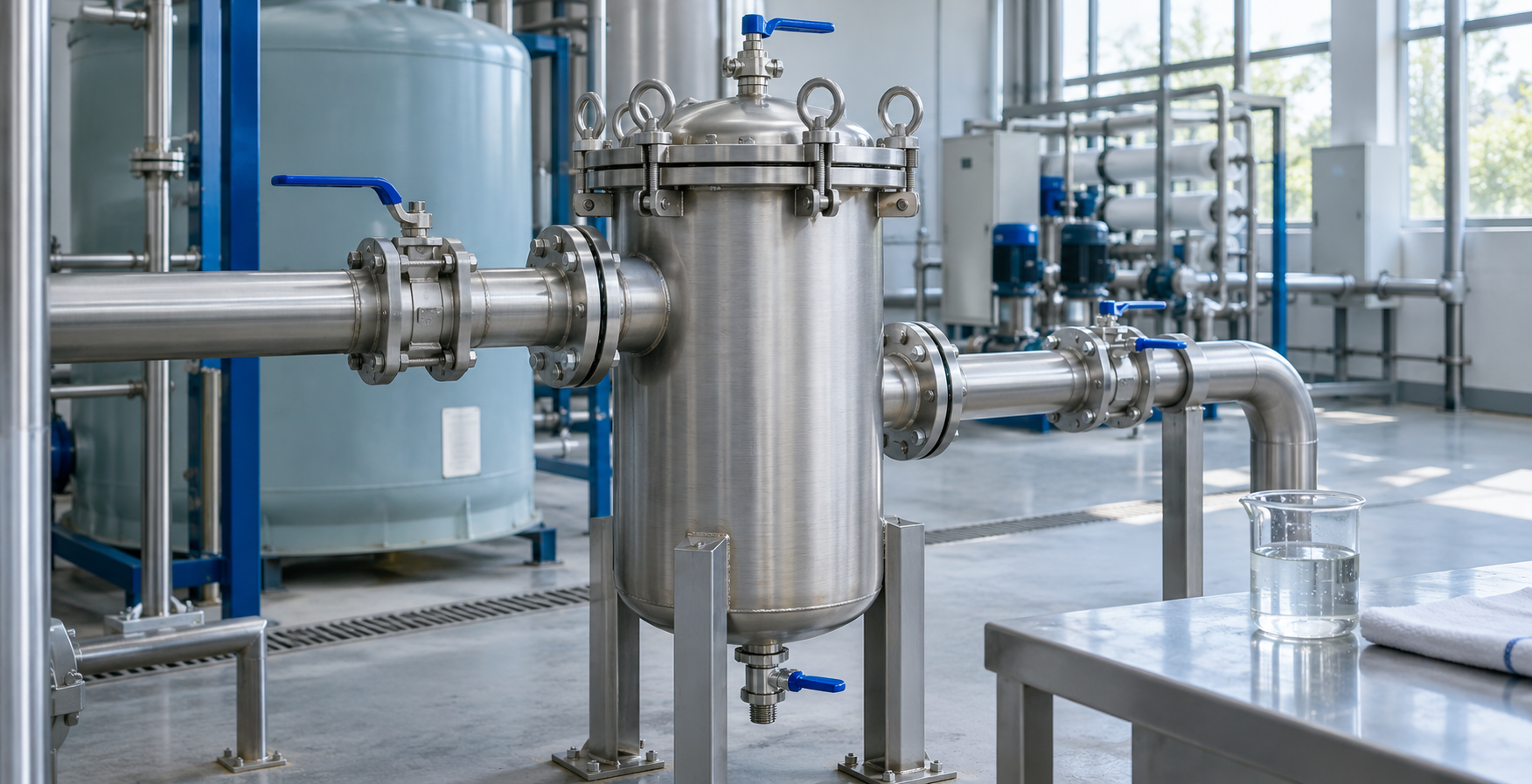
Start by describing the oil and the filtration objective, then check the complete filter bag and housing assembly. The right choice depends on the liquid composition, viscosity, temperature, particle load, flow and operating schedule. A micron rating alone cannot establish compatibility or service life.
Describe the oil and the process conditions
Identify the liquid as specifically as the project allows: for example, a cutting fluid, lubricant, hydraulic oil or oily wastewater. Record the composition or concentration range, normal and peak temperature, viscosity or how it changes with temperature, flow, run time and the particles to be removed. If the liquid contains water, emulsifiers, additives or cleaning agents, include those details in the review.
Different oils and mixtures can behave differently in filtration. Eaton lists oil-related duties among industrial bag-filter applications, but the suitability of any particular bag still depends on its material and the actual process conditions. Confirm the application with the selected product documentation and supplier.
Check the bag, seal and housing as a set
Confirm the bag material and construction, stitching, collar dimensions, bag length, support basket and the housing’s sealing arrangement. If a cartridge or other element is being considered, identify its end caps, core, support layers and seals as well. Ask how the stated micron rating is defined and what test basis applies; do not assume that matching numbers from different suppliers mean equivalent performance.
For viscous liquids or changing particle loads, review effective filter area, intended flow, pressure trend and replacement access. Verify that the housing pressure and temperature limits, wetted materials and seal compound fit the duty. A media choice that captures the target particles may still be unsuitable if a seal or another wetted component is incompatible.
If the liquid is hot, flammable or hazardous, have equipment selection, electrical or grounding provisions, ventilation, maintenance and waste handling reviewed under the project design and site safety procedures. Do not trade away housing or seal compatibility to pursue a finer rating.
Prepare useful information for a supplier review
Share the oil name or composition range, temperature, viscosity, flow, target particles, current element and housing model, replacement interval and photos of the used bag. If the oil is heated or exposed to cleaning agents, include those conditions. The supplier can then check the specific media, collar, seal and housing against available product data. Where production testing requires special controls, have process and safety personnel agree on the sampling and trial method first.
Record the selected element model, batch, material, seal details, installation date and service observations. Recheck the selection if the oil, additive package, temperature or cleaning procedure changes.
Bag filter products and inquiries
Shenzhen Guangxiangyu Technology Co., Ltd. supplies bag filter housings, filter bags and precision filters. For an oily-liquid filtration discussion, provide the fluid information, temperature, viscosity, flow, target particles and current equipment model to Liu Nan, Sales Manager, at LiuNan2553@gmail.com. Confirm compatibility and performance for the exact bag and operating conditions before adopting a selection.
See our bag filter housings, filter bags and contact page.
Technical reference
- Eaton: Filter Bags for Fine and Coarse Industrial Filtration. Eaton lists several oil-related industrial filtration applications; confirm compatibility for the specific media and process.
- Parker O-Ring Handbook. Use seal compatibility data for the actual compound and operating conditions.