
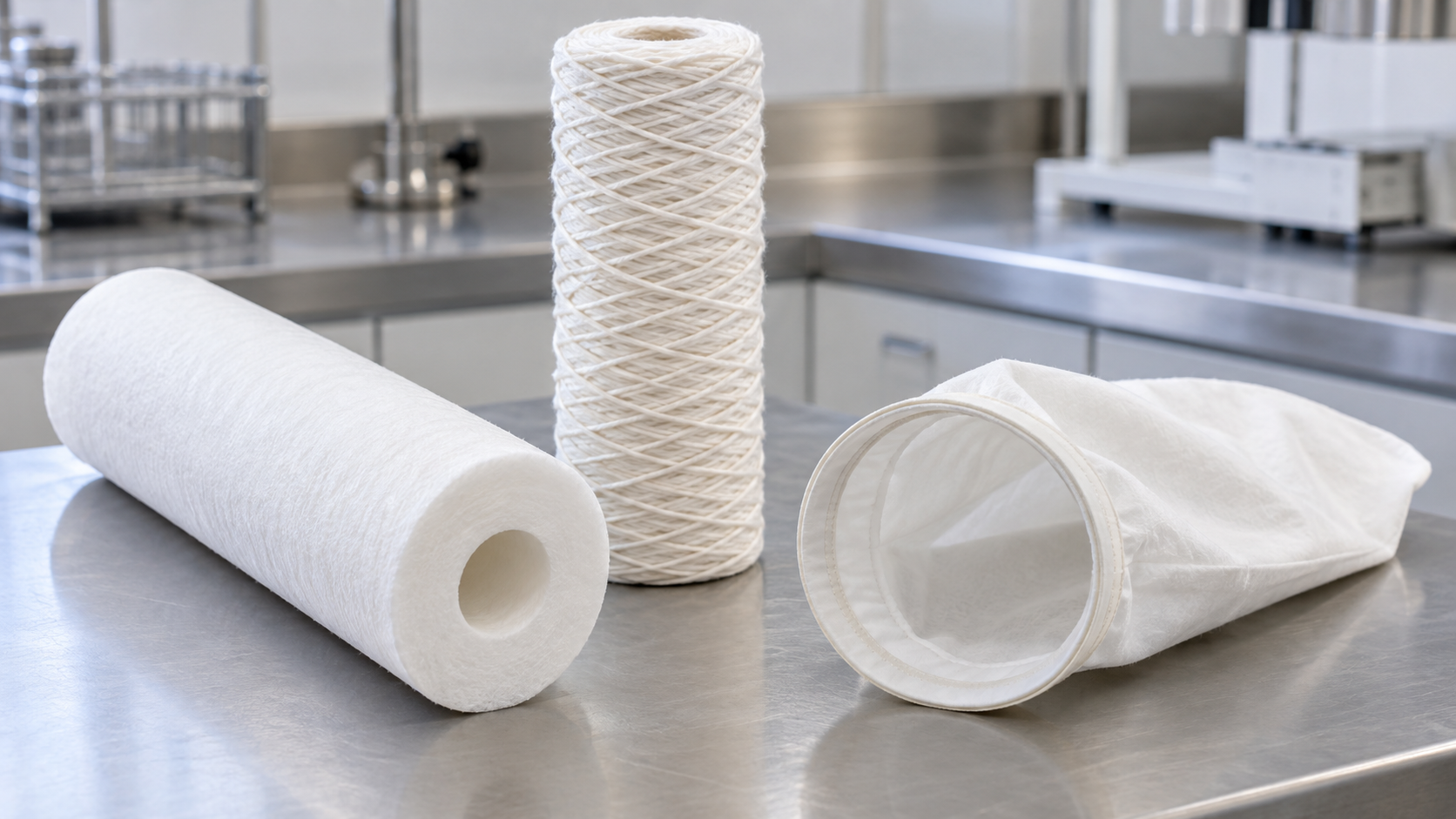
A cartridge marked "PP" does not, by itself, establish whether the complete cartridge is suitable for a particular liquid. Filter media, the central core, end caps, joining materials and seals may all contact the liquid. Temperature, concentration, cleaning agents and continuous operating time also affect compatibility. Before purchasing, confirm the complete construction and ask the supplier for material information or a written assessment against the actual conditions.
Different suppliers may use "cartridge material" to describe only the main filter media. The description may not include the core, end caps or seals. Replacing an existing cartridge using a material abbreviation alone can overlook dimensional differences, sealing bypass or unsuitable operating conditions. Review material, construction, filtration rating and housing model together.
1. Four steps for checking cartridge materials
| Step | Information to confirm | Records to retain |
|---|---|---|
| Describe the liquid | Composition, concentration range, additives and cleaning agents | Process information or safety data; identify unknown conditions as pending confirmation |
| Define the temperature conditions | Normal temperature, peaks, heating and cleaning conditions | Operating records for the process |
| Review each component | Media, core, end caps, joining method and seals | Product construction information or a component material list |
| Confirm how the cartridge will operate | Continuous operating time, pressure, any backwashing or cleaning, and acceptance criteria | Equipment instructions, cartridge data and site validation results |
Keep these details connected to the exact cartridge model. A material statement without the liquid composition or temperature range cannot resolve all the conditions that need checking for the application.
2. Four common claims that need follow-up questions
"This is a PP cartridge." Which components of the complete cartridge are PP? What materials are used in the other wetted components?
"It resists acids and alkalis." Which liquid, concentration, temperature and exposure time does that statement cover? What supporting information is available?
"It is a universal cartridge." Do the outside diameter, length, end connection, sealing arrangement and housing model match individually?
"The micron rating is the same." How is the rating defined: nominal, rated or absolute? Are the test methods and operating conditions comparable?
These questions help turn a broad description into information that can be checked against the installed equipment and process. Matching one label does not confirm every component or operating requirement.
3. What to do when material information is incomplete
If the supplier cannot yet provide a complete material description, do not treat previous use by another customer as proof of compatibility for every application. First confirm the actual liquid composition and temperature range, then ask whether suitability documents, samples or a limited validation arrangement are available.
For a process that is critical to product quality, validation and changes should also follow the company's internal approval procedures. Identify the conditions that still need confirmation before expanding use of a replacement cartridge.
4. Keep records after a cartridge change
After replacement, observe cartridge appearance, sealing, differential pressure and outlet quality. Retain batch information so that unusual results can be traced to the media installed and the conditions under which it operated.
If an unusual odor, color change, fiber shedding, swelling or abnormal blockage appears after replacement, stop using the cartridge according to the process safety requirements. Review samples, cartridge batch information and operating records.
The observation alone does not establish a material-related cause. It should be investigated rather than used to make an immediate assumption, or ignored while the cartridge is introduced into more applications.
5. Related Guangxiangyu Tech consumables
Shenzhen Guangxiangyu Technology Co., Ltd. was established in 2009 and is based in Longgang District, Shenzhen. We supply industrial liquid filtration equipment and water treatment cartridges.
Relevant products include PP melt-blown cartridges, plating filter cartridges, water treatment cartridges and cartridge filter housings. Check each consumable against the liquid, temperature, pressure and target particles. This guide does not establish general corrosion resistance for a liquid whose composition has not been provided.
Explore our filter cartridges, cartridge filter housings and company information. For a compatibility discussion, send liquid information, temperature, pressure, the old cartridge model or photos, housing dimensions and the filtration objective to Liu Nan, Sales Manager at LiuNan2553@gmail.com.
Final suitability should be supported by product information and validation results for the specific conditions.
6. Frequently asked questions
Can cartridges with the same appearance be exchanged directly? Not necessarily. Check length, end connections, seals, materials, rating definitions and operating limits as well as appearance.
What if the supplier provides only a material abbreviation? Request component materials, applicable conditions and written confirmation. Where information is insufficient, validate the choice before using it in a critical production process.