
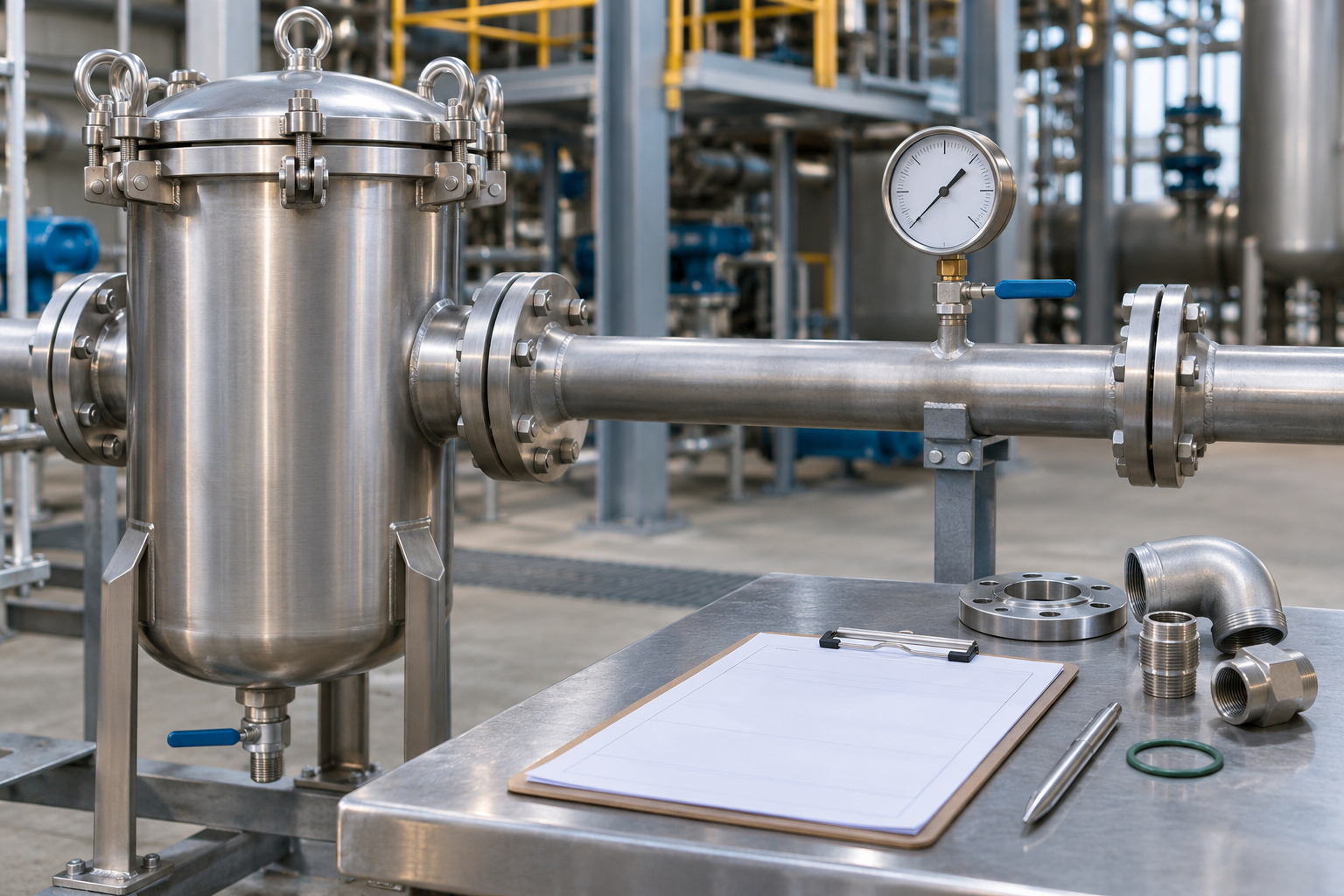
A pressure reading is useful only when the measurement point, range, units and operating conditions are clear. The location of a gauge should follow the process design and equipment requirements; do not add a connection to a housing based only on general experience. To determine the pressure difference across a filter, confirm how the inlet and outlet measurement points and instruments are arranged.
Start with the measurement purpose
Clarify whether the system needs pump-discharge pressure, filter inlet and outlet pressure, or pressure in another section of pipe. Identify each point relative to the equipment, valves and bypass so that local losses or other equipment do not confuse the reading. The responsible engineer should check the measuring point, range and connection method against the approved design.
Make routine readings comparable
Record the instrument identification, range, units, calibration status and reading time. Also record flow, pump operating mode, valve positions and liquid temperature. Note when an instrument is replaced, repaired or moved so that readings from different arrangements are not treated as one continuous trend. A pressure gauge alone does not determine filter-media condition and does not replace equipment safety protection.
Use the drawings to confirm the measurement points
The definition, position and range of the upstream and downstream measurements affect how the readings should be interpreted. Use the approved process flow diagram and equipment drawings to confirm that the points correspond to the section being monitored. If calculating filter differential pressure, take both readings under the same operating conditions and make sure the two points represent the same flow path.
Parker's vessel manual describes taking pressure readings upstream and downstream of the specified filter to determine differential pressure. That example does not establish a universal gauge location for other equipment; use the approved design and instructions for the installed system.
Check the installation before acting on a reading
If the filter's own pressure drop is being monitored, confirm that the points are on the intended sides of the equipment and that bypass piping or valve positions are recorded. If a gauge pointer fluctuates or the reading is unstable, check the instrument and connection conditions before concluding that the media is blocked. Any work involving pressure-rated equipment must follow the drawings and site safety procedures. Do not drill or modify a housing while it is in service; changes must be planned and approved by qualified design or maintenance personnel.
Filter and instrumentation inquiries
Shenzhen Guangxiangyu Technology Co., Ltd., established in 2009 in Longgang District, Shenzhen, supplies bag filter housings, precision filters and compatible media. For an instrumentation configuration discussion, share the process drawing, measurement purpose and equipment information with Liu Nan, Sales Manager, at LiuNan2553@gmail.com. The design team should confirm gauge location, range and safety requirements from the project documents.
See our bag filter housings, precision filters, or contact page.
Technical reference
- Parker, Micronic Prefilter Vessel Installation and Operation Manual. The manual describes an upstream and downstream pressure reading for determining differential pressure on the specified vessel; follow the instructions for the actual installation.