
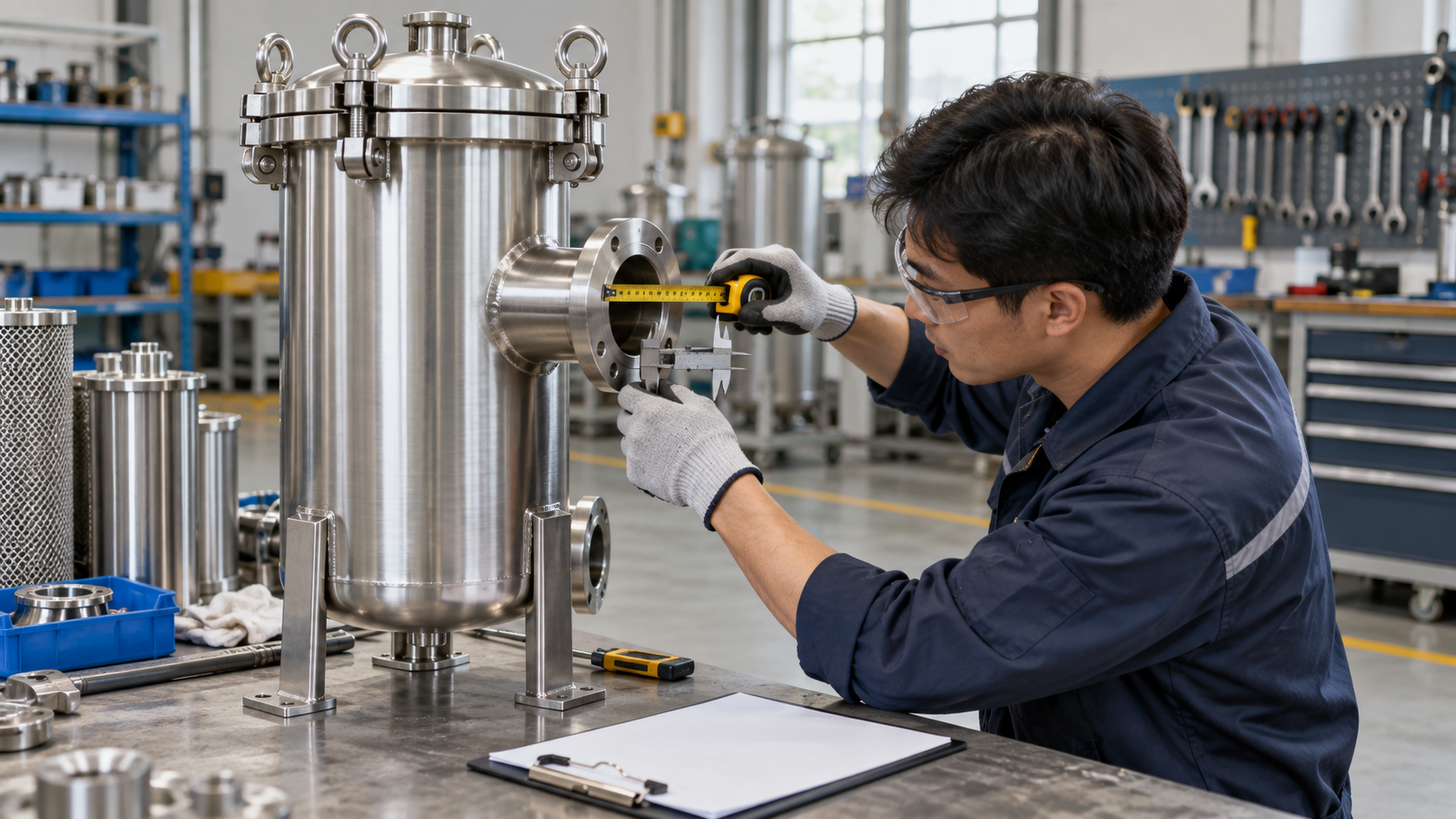
Pipe diameter is one input to an industrial filter quotation. It does not, on its own, define capacity, filtration objectives, housing material or pressure rating. To compare quotations, place equipment construction, media, seals, accessories and delivery scope in the same comparison table. A difference in total price may reflect different configurations.
The same connection size can be used with a single-bag, multi-bag or cartridge filter arrangement. Bag dimensions and materials, cartridge quantity, wetted housing materials, working temperature and pressure can also differ. An inquiry based only on diameter may produce an approximate reference price, but it cannot establish that the complete configuration suits the production conditions.
1. Seven parts of a quotation to compare
| Item | Questions to clarify |
|---|---|
| Equipment construction | Is it a single-bag, multi-bag, quick-opening, basket or cartridge filter? What model and drawings are included? |
| Wetted materials | What materials are used for the housing, internals, media and seals? |
| Design conditions | How are flow, working temperature, design pressure and operating pressure defined? |
| Consumable configuration | What bag or cartridge sizes, quantities, rating definitions and spare media are included? |
| Connections and accessories | Which inlet and outlet connections, vents, drains, gauges and valves are included? |
| Delivery and service | What is included for packaging, transport, installation, commissioning, taxes, after-sales support and delivery time? |
| Acceptance method | Which liquid sample, flow conditions and test method will establish whether the agreed objective is met? |
Compare stated configurations before comparing the totals. If an item is not described, ask for clarification rather than assuming it is included in both proposals.
2. Operating information to provide before requesting a price
Provide the liquid name and source, main contaminants and filtration objective, normal and peak flow, working temperature and pressure, and bag or cartridge rating requirements. Include the site pipe size, installation space and whether maintenance shutdowns are possible.
If a complete liquid-quality report is not available, identify the unknown parameters and arrange sampling or further measurement where needed. Do not treat an estimated value as a final technical condition.
This information allows the supplier to discuss a configuration against an identifiable duty. A budget estimate based on incomplete conditions should clearly state what remains to be confirmed.
3. Review quoted performance claims in context
After receiving quotations, compare each supplier's model, materials, consumables, accessories and acceptance scope item by item. For claims such as maximum flow or filtration rating, ask for the associated test conditions and product documentation.
The final model, materials and performance requirements should be recorded in the technical agreement or contract attachment. A connection dimension remains part of that agreement, but should not replace the rest of the specification.
4. Put confirmed conditions into a technical specification
Summarize the confirmed information in a concise technical conditions sheet: liquid and filtration objective, design flow, temperature and pressure, housing and wetted materials, bag or cartridge models, connection sizes, instruments, spare quantities and acceptance method.
For parameters that remain open, name the responsible party and the point at which confirmation is required. Where material compatibility or filtration performance has special requirements, specify the supporting documents or site tests needed.
Keeping these conditions with the quotation makes it easier for both parties to distinguish an agreed specification from a provisional assumption.
5. Retain equipment information for future changes
After purchasing, keep the nameplate information, drawings, consumable list and operating instructions. These records help a supplier understand the original equipment limits when replacement media or an expansion is discussed later.
They also reduce reliance on guessing a model from its connection size or appearance. For custom dimensions, compare the final drawings with site measurements again before installation to identify connection mismatches or insufficient maintenance clearance.
6. Guangxiangyu Tech filtration products
Shenzhen Guangxiangyu Technology Co., Ltd. was established in 2009 and is based in Longgang District, Shenzhen. We supply industrial liquid filtration equipment and water treatment cartridges.
Our range includes stainless steel single-bag, multi-bag and quick-opening bag filter housings, basket filters, oil filtration bag filter housings and cartridge filter housings. Consumables include filter bags, plating filter cartridges, PP melt-blown cartridges and water treatment cartridges.
We can discuss product selection and custom configurations using the operating information supplied. The specific configuration must be checked against site conditions and cannot be determined from pipe diameter alone.
See our product range, bag filter housings and cartridge filter housings. Send quotation information to Liu Nan, Sales Manager at LiuNan2553@gmail.com. Both parties should confirm the final model, materials, pressure limits, consumables and acceptance criteria.
7. Frequently asked questions
Can I request a budget price before the final operating conditions are available? Yes. Begin with the information known, while identifying assumptions and pending conditions. Changes to the operating requirements may affect configuration and price.
What should I check first when two prices differ substantially? Compare equipment models, wetted materials, consumables, operating conditions and delivery scope on the same basis before comparing total prices.