
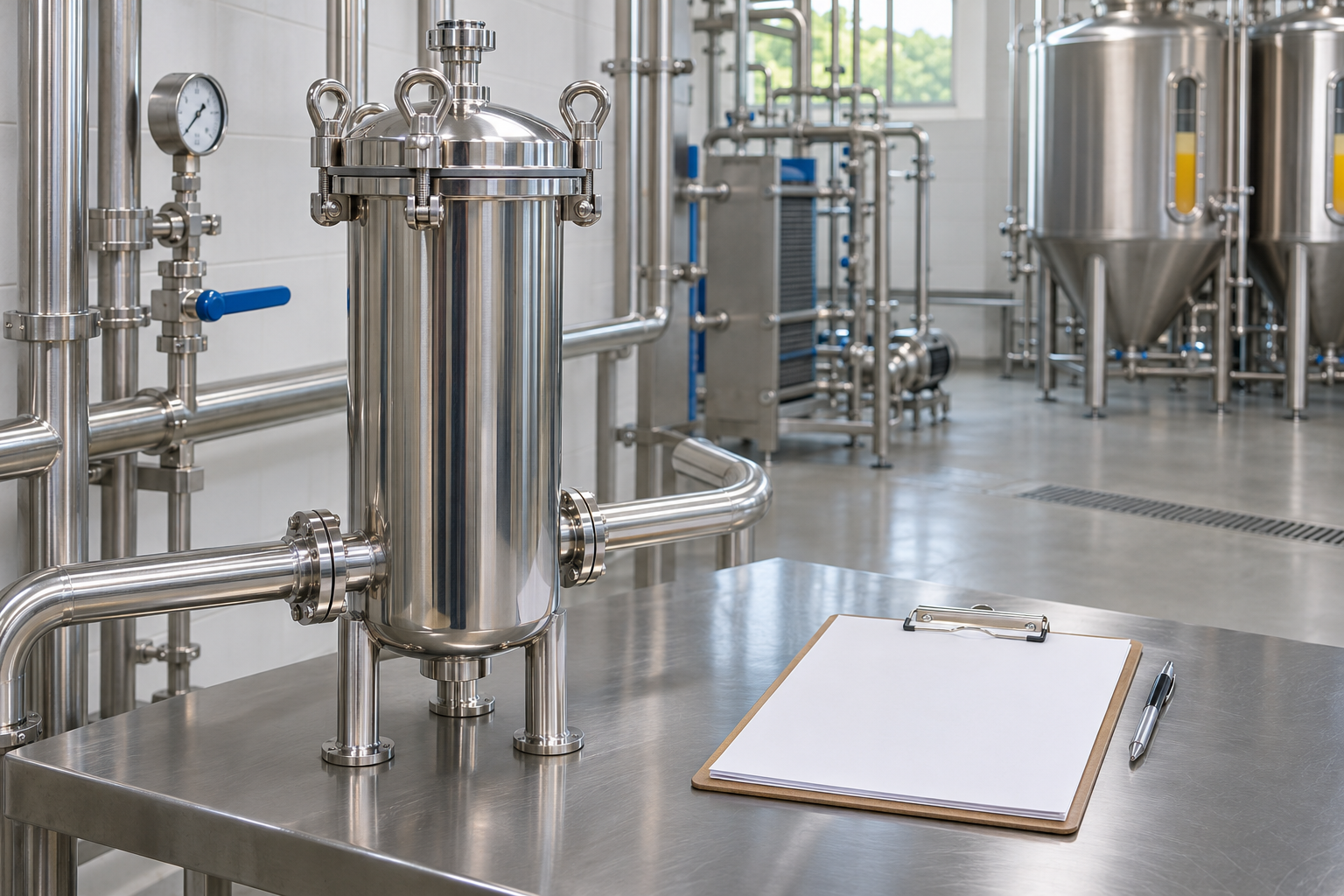
A useful filter selection form records the process, target and installation conditions in one place. At minimum, capture the liquid, flow, temperature, pressure, particle objective, operating pattern, downstream requirement and available maintenance space. The form helps suppliers compare options; it does not replace engineering calculations or product confirmation.
Organize the form into four sections
| Section | Fields to include |
|---|---|
| Liquid and objective | Liquid name or composition range, particle source, target result and downstream requirement |
| Operating conditions | Normal and peak flow, temperature, pressure, continuous or intermittent operation, cleaning method |
| Equipment and connections | Existing housing model, inlet and outlet connection, material requirements, flow direction and available space |
| Maintenance and purchasing | Allowed downtime, change-out method, element model and frequency, spares and document requirements |
Add units to every numeric field. If viscosity, particle size or another important value is unavailable, mark it “to be tested” or “to be confirmed on site” instead of leaving a blank that could be mistaken for zero.
Separate measured data from assumptions
Record where each value came from and when it was measured. Label entries such as “pump nameplate,” “field measurement,” “laboratory report” or “estimate.” Keep routine and peak conditions separate so an average does not hide short-term surges. If the target particle is unclear, attach a sample description or test plan. If space is uncertain, mark the dimension for a site survey.
Ask each supplier to state its design assumptions, element construction, rating definition and application limits. Compare proposals using the same stated operating conditions. Eaton’s cartridge manual, for example, lists filtration target, throughput and filterability among the inputs used in sizing for the applications it covers; the exact inputs depend on the product and process.
Use the completed form to close information gaps
Attach the process diagram, equipment nameplate and site photographs when they help explain the installation. Review which items are required, optional or still open. When a proposal is returned, copy the supplier’s assumed conditions back into the form and have engineering and purchasing confirm them before quotation approval or ordering.
A conditional estimate can still be useful while data is incomplete, provided each assumption is clearly marked and the outstanding measurements or analyses have an owner.
Filter products and inquiries
Shenzhen Guangxiangyu Technology Co., Ltd. supplies bag filter housings, precision filters, filter bags and cartridges. For a filter selection discussion, share the completed form, process diagram, site photos and any water or liquid analysis with Liu Nan, Sales Manager, at LiuNan2553@gmail.com. The project owner should confirm design pressure, materials and acceptance requirements for the actual application.
See our bag filter housings, precision filters and contact page.
Technical reference
Eaton Filter Cartridge Manual. Its sizing examples are product- and application-specific; confirm the selection inputs for the cartridge and process under consideration.