
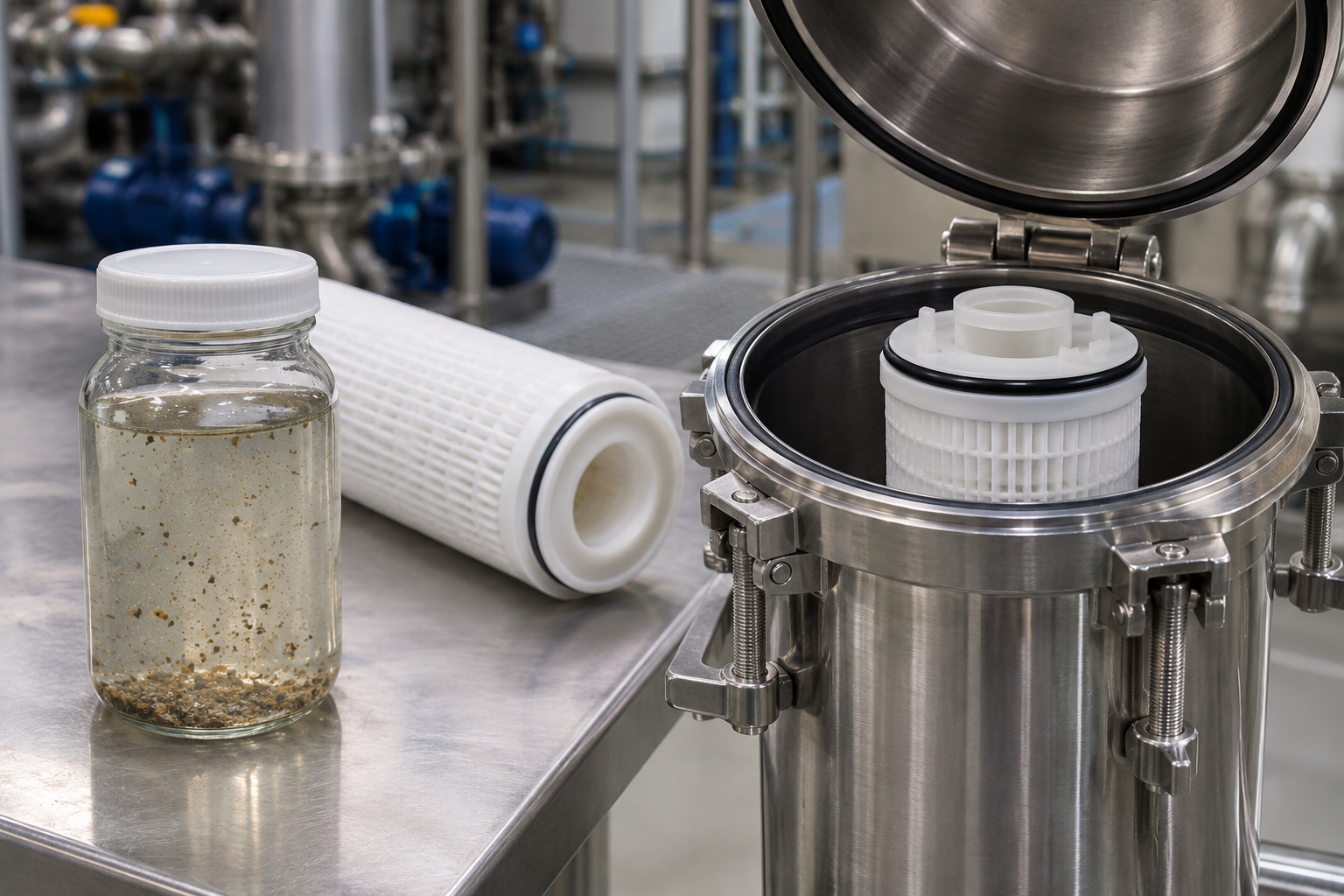
Saying only that a liquid contains “impurities” gives little information for selecting a filter. Record the likely source, colour, shape, whether the material settles, how often it appears and what changed in the process. Representative photos or samples may help when collected and handled safely. Appearance can guide an investigation, but it does not identify a particle or contaminant on its own.
Make observations repeatable
Record the sampling time and location, equipment operating condition, production batch and whether the sample was allowed to settle. Photograph it in a clean, transparent container against a consistent background; different lighting can make colour comparisons misleading. If particles settle or the sample may change over time, ask the process team or testing laboratory how to collect, preserve and transport it.
Label the sample with the source, date, time and location, and note the conditions at collection. EPA sampling guidance also emphasizes identifying sample containers and protecting sample integrity. The correct container, preservation and transport depend on the liquid and the analysis requested, so follow the laboratory's instructions.
Turn “impurities” into a filtration target
Tell the equipment supplier what downstream equipment needs protection, what particle condition or test result matters, and the flow, pressure, temperature and maintenance constraints. If the concern may involve dissolved substances, oil, microorganisms or chemical composition, do not assume that a particle filter will address it. A water-quality report or a controlled trial may be needed to see whether a proposed media addresses the target.
Include a reference in photos and sample records
Take both an overall and a close-up photo, using a clean container and a scale or other reference where useful. Note the process step, sampling point, date and operating state. Describe particle colour and shape, whether it settles, and whether it feels soft or adheres only when it is safe and appropriate to handle the material. A visual check cannot replace laboratory analysis when the selection depends on particle identity or a measured limit.
When contacting a supplier, also state whether the goal is to protect downstream equipment, improve appearance or meet a specified test result. If the liquid changes by production batch, records or samples from more than one time may be more useful. Agree on the filtration target first, then discuss rating, media construction and a way to verify the result.
Filtration equipment inquiries
Shenzhen Guangxiangyu Technology Co., Ltd., established in 2009 in Longgang District, Shenzhen, supplies bag filter housings, precision filters, filter bags and cartridges. For a selection discussion, share contaminant photos, available test reports, sampling conditions and operating data with Liu Nan, Sales Manager, at LiuNan2553@gmail.com. Confirm the required performance under the actual process conditions.
See our bag filter housings, precision filters, or contact page.
Technical reference
- US EPA, NPDES Storm Water Sampling Guidance Document. The guidance discusses sample identification, collection records and sample integrity; use the laboratory's method for the liquid and analysis in question.