
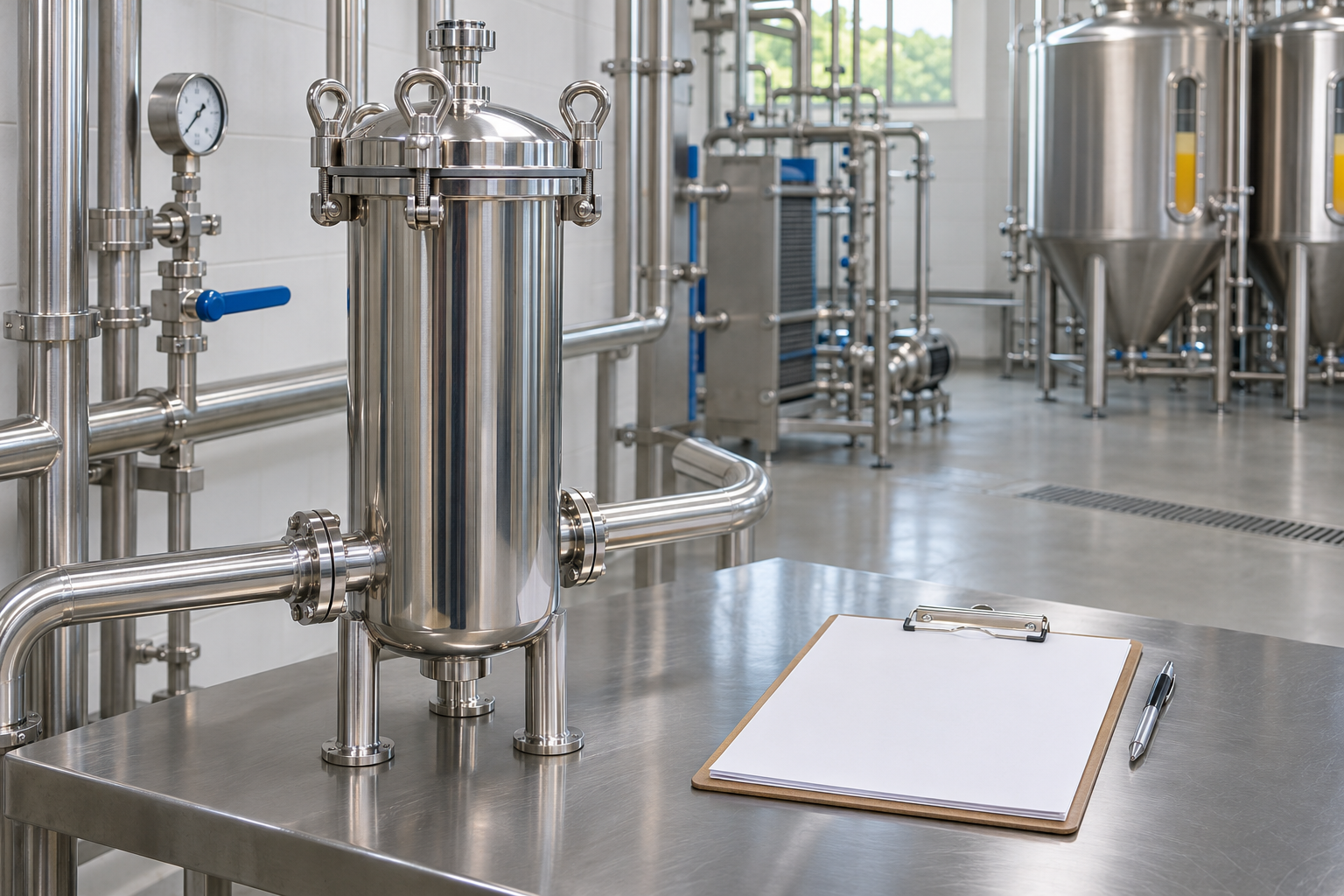
“Hygienic” or “sanitary grade” is too broad to serve as a complete filter specification. Describe the liquid, process step, wetted components, cleaning method, required records and applicable project standards. Ask the supplier for documents that identify the specific model and components. The quality, process and regulatory owners must determine whether the proposed equipment meets the requirements that apply to the facility and product.
Define the wetted parts and documentation needed
List every component that may contact the process liquid, including the housing, basket, filter media, seals, end caps and connections. State any material, surface-finish or construction requirements in the project specification. If the filter is used on a product-contact step, identify the required evidence for materials, certificates, batch traceability and component scope.
Do not infer that an entire filter assembly is compliant from a product name, marketing term, housing material or a single certificate. Check what the document covers: the complete assembly, a particular wetted component, a material grade or a specific product family. Ask the supplier to map its documents to the exact model and parts being quoted.
Describe cleaning and process validation needs
Provide liquid composition, operating temperature, contact time, cleaning agents, cleaning frequency and whether the filter is cleaned in place or disassembled. Identify who defines the sample points and acceptance criteria for cleaning verification or filtration performance.
Food and pharmaceutical regulations apply according to the product, process and jurisdiction. As examples, U.S. food equipment rules address cleanability and maintenance, while pharmaceutical CGMP rules address equipment construction and cleaning. These examples do not establish requirements for every market or application; the project quality and regulatory teams should identify the applicable rules and standards.
A filter housing by itself does not establish that a process is sanitary, sterilized or aseptic. Requirements for sanitization, sterilization, cleaning validation and product protection must be reviewed as part of the complete process design.
Turn general language into verifiable purchase requirements
Use a technical clarification sheet to list the wetted-parts schedule, material documents, cleaning compatibility, batch records, delivery documents and who reviews each item. Replace broad terms such as “food grade” or “sanitary” with the named standard, document type, applicable components and scope that the project requires. Mark missing evidence as an open item before purchasing.
| Requirement area | What to specify |
|---|---|
| Process | Liquid, process step, temperature and operating time |
| Wetted parts | Housing, basket, media, seals, end caps and connections |
| Cleaning | Cleaning agents, frequency, temperature and method |
| Evidence | Required certificates, material records and batch traceability |
| Verification | Sample points, criteria and responsible reviewers |
| Regulatory scope | Applicable jurisdiction, standard and product-contact status |
Filter products and inquiries
Shenzhen Guangxiangyu Technology Co., Ltd. supplies bag filter housings, precision filter housings and compatible filter bags and cartridges. For a food or pharmaceutical application discussion, share the written requirements and the liquid and cleaning conditions with Liu Nan, Sales Manager, at LiuNan2553@gmail.com. Review certificates and compliance claims for the exact product and components with the project’s quality and regulatory owners.
See our bag filter housings, precision filters and contact page.
Technical references
- U.S. eCFR: 21 CFR 117.40, Equipment and utensils.
- U.S. eCFR: 21 CFR 211.65, Equipment construction, and 21 CFR 211.67, Equipment cleaning and maintenance.
These U.S. provisions have specific scopes; the responsible quality and regulatory teams must confirm which requirements apply to a project.