
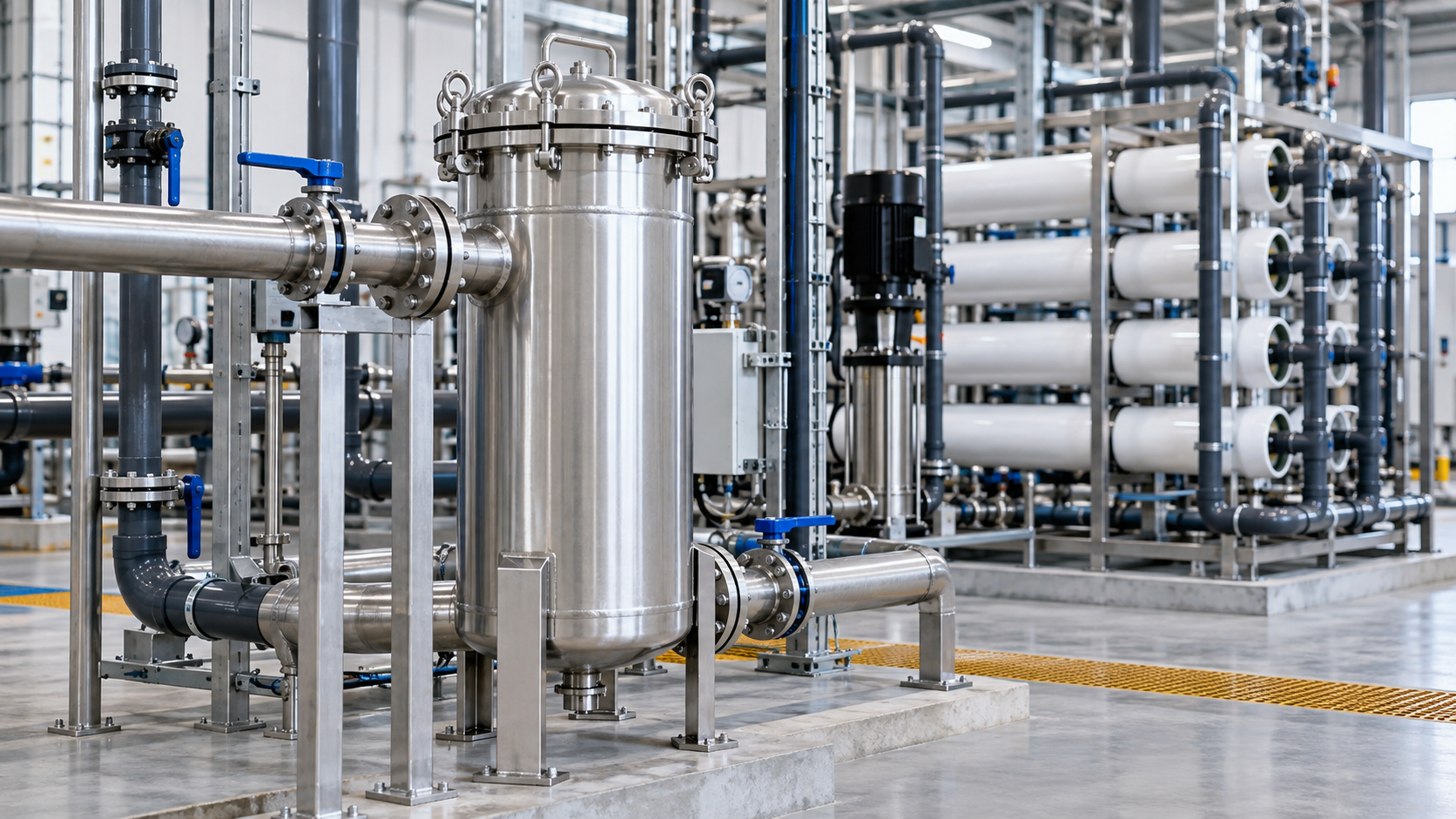
Start with the process, not a micron number. The right wastewater pretreatment filter depends on the particles to be removed, the actual flow rate and the requirements of the equipment or process downstream. A bag or cartridge filter can capture particles that are compatible with its media; it does not replace desalination, water softening or a complete wastewater treatment system.
Industrial wastewater can change with production steps, cleaning cycles and reuse rates. The same filter may perform differently when the liquid, solids load or maintenance schedule changes. Before requesting a quotation, clarify what needs to be captured, what equipment needs protection and how often the system can be serviced.
1. Define the treatment objective
| Objective | Information to confirm | What filtration can and cannot do |
|---|---|---|
| Capture visible particles, rust or fibers | Particle size, shape and whether the solids load varies | A compatible bag or cartridge may retain particles; verify performance with the actual process |
| Reduce particle loading before downstream equipment | The downstream equipment maker's inlet requirements | A prefilter can be one treatment stage; it does not guarantee the complete system will meet its final water target |
| Filter oily, viscous or floc-containing liquid | Oil content, viscosity, temperature and solids behavior | Media compatibility, blockage rate and service method need to be reviewed |
| Meet a dissolved-salt, hardness or chemical target | Water analysis and the required treatment outcome | A standard bag or cartridge filter does not remove dissolved salts or replace the relevant treatment process |
2. Match the filter to operating conditions
Identify the liquid and contaminants. Provide a recent water analysis or sample where possible. Describe whether the solids are sand, rust, fibers, precipitates or flocs. “Dirty wastewater” alone is not enough to select a reliable media type or filtration rating.
Confirm normal and peak flow. State the usual flow rate, peak flow and whether operation is continuous or intermittent. If production cannot stop easily, discuss the available maintenance window, standby equipment or piping arrangement before choosing a housing.
Review temperature, pressure and material compatibility. The vessel, filter media and seals must all suit the liquid and cleaning method. If the chemistry is unknown, do not select a material from a grade name alone. Confirm compatibility against the product data and the actual process conditions.
Check the downstream process. If the filter protects a reverse-osmosis system, spray nozzle or precision process, obtain that equipment's inlet requirements first. A prefilter can only handle the particle-removal duty for which it is selected; the complete treatment train must be validated against the final water-quality target.
3. Decide whether one or more filtration stages are needed
Where incoming solids are high, an engineer may evaluate a bag filter to capture larger suspended particles before a finer cartridge stage. Whether two stages are appropriate depends on water quality, flow, media loading and maintenance cost. It is not necessary to apply the same arrangement to every project. Compare our bag filter housings and cartridge filter housings, then confirm the duty with process data.
The filtration rating should follow the target particle and downstream requirement. A finer rating can increase media loading and service frequency. If the wastewater contains dissolved contaminants, chemical treatment, membranes or another process may also be required.
4. Information to include in a quotation request
Send the liquid name and available analysis, contaminant description, normal and peak flow, operating pressure and temperature, target particle size, downstream equipment requirement, connection standard and expected maintenance conditions. Photos of the existing line or housing can help clarify space and connection constraints. Mark unknown values as unknown instead of guessing.
Filtration products from Guangxiangyu Tech
Shenzhen Guangxiangyu Technology Co., Ltd. has supplied industrial filtration products since 2009. The range includes stainless steel single-bag, multi-bag and quick-opening filter housings, cartridge housings, filter bags, PP melt-blown cartridges and plating filter cartridges. We can discuss product selection and custom configurations using the process details provided. The final specification and performance must be confirmed for the actual application.
For particle prefiltration, start with the bag filter product range and filter bag options. If the downstream process requires a cartridge stage, share the cartridge model, length and housing details.
Frequently asked questions
Will installing a filter make wastewater suitable for reuse? Not by itself. A filter may capture compatible particles. Reuse suitability must be tested against the intended use and the complete treatment process.
Can I request a quotation before a full water analysis is available? Yes. Share the information you have, identify the missing data and provide a sample or site photos where possible. Treat any preliminary configuration as provisional until key conditions are confirmed.
To discuss an application, contact Liu Nan with the water analysis or sample details, flow, pressure, temperature, downstream requirements and maintenance constraints.