
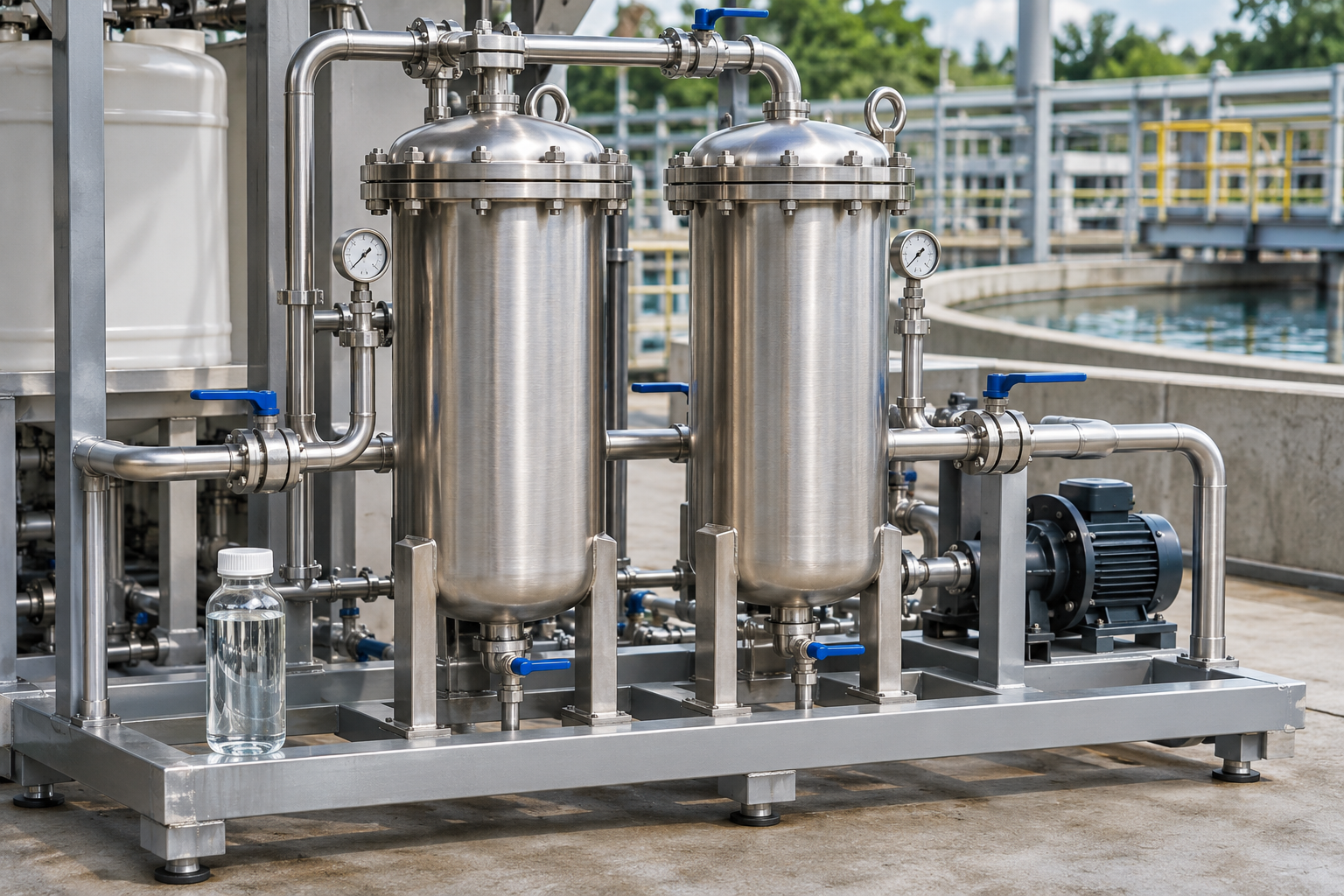
Pretreatment filtration can be one step in controlling particles, but it does not prove that water is suitable for every reuse purpose. Define the intended use and target water-quality measures first, then decide what testing and treatment train are needed. A particle filter is not, by itself, a complete system for removing dissolved salts, organic compounds or microorganisms.
Define the reuse application and its targets
Cooling make-up, wash water, process mixing and equipment protection can have different water-quality needs. List the downstream equipment requirements, sampling locations, parameters to be tested and expected variation in the incoming water before selecting a pretreatment unit. Clearer-looking water or a lower turbidity reading alone does not show that every reuse target has been met.
The US EPA's water-reuse guidance treats industrial reuse requirements in relation to the intended application. Use the applicable project and local requirements to establish the targets; do not apply criteria for a different use or location without review.
Define what the prefilter can handle
Assess bag filtration, precision cartridges or another particle-control method against the particle type and concentration, flow rate and available filtration area. If the targets include hardness, dissolved salts, chemical oxygen demand, metal ions or microorganisms, a water-treatment designer should assess the appropriate processes. Pretreatment may also need to protect a downstream membrane or resin system, but operating limits should come from the documentation for the exact equipment rather than being copied between models.
Treat reuse targets as a whole-system responsibility
Pretreatment usually addresses suspended particles within the capability of the selected media and design. It does not, on its own, solve every issue involving dissolved salts, organics or microorganisms. First define the use, incoming-water variation and target measures; then have the process designer assign the role of settling, filtration, membrane treatment or other units. State the filter's duty and acceptance measures clearly in the project documents.
Plan how results will be checked at the site
For a reuse proposal, list the parameters to control, sampling points, test frequency and response to out-of-range results by intended application. Then identify which of those parameters pretreatment filtration can support. Consider variations in reuse flow, waste or backwash from filter service, and how pretreatment connects to downstream units. If test data is missing, collect it before making a performance commitment.
Industrial filtration equipment inquiries
Shenzhen Guangxiangyu Technology Co., Ltd., established in 2009 in Longgang District, Shenzhen, supplies bag filter housings, precision filters and compatible media for industrial liquid and water-treatment applications. For a particle-control discussion, share the intended reuse application, available water-quality data, flow and downstream requirements with Liu Nan, Sales Manager, at LiuNan2553@gmail.com. The complete treatment design and reuse acceptance criteria should be confirmed by the project team.
See our bag filter housings, precision filters, or contact page.
Technical reference
- US EPA, 2012 Guidelines for Water Reuse. The guidance discusses treatment and monitoring considerations for different reuse applications, including industrial uses with site-specific requirements.