
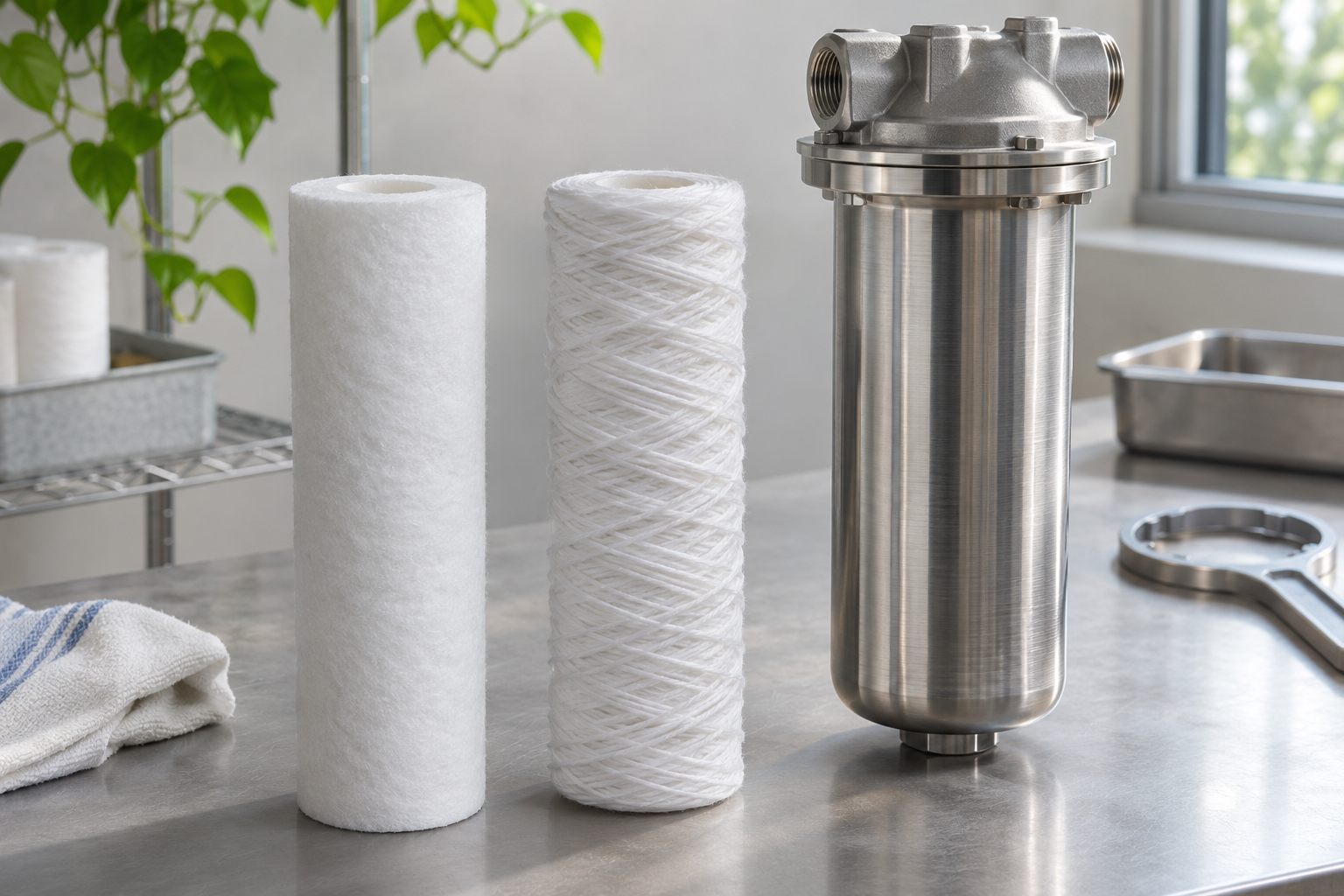
The names “melt-blown” and “string-wound” describe different cartridge constructions; they do not by themselves tell you which cartridge is finer or will last longer. Compare the intended particle target, liquid, flow, cartridge dimensions, end fittings, seal materials and the supplier’s rating data. Use consistent operating conditions if you are comparing service performance.
Compare construction and product data
A melt-blown cartridge is formed from fibers into a depth-filter structure. A string-wound cartridge uses yarn wound around a core to create its filtration structure. The details can vary by manufacturer and product line, including media material, support, core, end caps and seals. Do not assume every product within either category has the same construction or performance.
Ask the supplier how the micron rating is defined, what test method and efficiency apply, and which exact model the data describes. For example, Eaton’s industrial cartridge overview lists different media constructions and product families with their own rating and material information. A matching micron number from two product labels is not enough to establish equivalent retention.
Compare under the same operating conditions
Provide the liquid composition, temperature, viscosity, flow and particle loading, along with the downstream equipment requirement. Confirm that each candidate’s materials and seals suit the liquid and any cleaning conditions. Check cartridge length, end connection and housing fit before focusing on service life.
Where a controlled trial is appropriate, use the same housing, similar liquid, flow, sample points and operating period. Record initial pressure, flow trend, run time, where loading appears and why each cartridge is replaced. Note changes in feed quality or production batches. Results from one short trial describe that trial’s conditions; they do not prove a universal service-life ranking for either construction.
Keep the comparison traceable
Record each cartridge model and batch, rating definition, material, end fitting, seal, installation date, operating readings and replacement reason. If candidates come from different suppliers, check that their test and reporting bases are comparable. Reassess the comparison if the process or feed changes.
| Comparison point | Information to collect |
|---|---|
| Filtration target | Particle type, downstream need and sample method |
| Rating | Definition, test method and efficiency claim for the exact model |
| Construction | Melt-blown media or wound yarn, core and support details |
| Compatibility | Liquid, temperature, cleaning conditions and wetted materials |
| Fit | Length, end cap, seal and housing compatibility |
| Trial | Flow, pressure, duration, feed conditions and change-out reason |
Filter products and inquiries
Shenzhen Guangxiangyu Technology Co., Ltd. supplies PP melt-blown cartridges, electroplating cotton-core cartridges, precision filter housings and related products. For a comparison, share the current model, liquid conditions, target particles and operating records with Liu Nan, Sales Manager, at LiuNan2553@gmail.com. Confirm performance using the technical data and verification results for the specific products under consideration.
See our filter cartridges, precision filter housings and contact page.
Technical references
- Eaton Industrial Process Filter Cartridges Overview describes product families with different media constructions, ratings and materials.
- Donaldson PP Melt-Blown Liquid Filter Cartridges describes its melt-blown product family. Product claims apply to the products shown; compare the data for the exact cartridge model selected.