
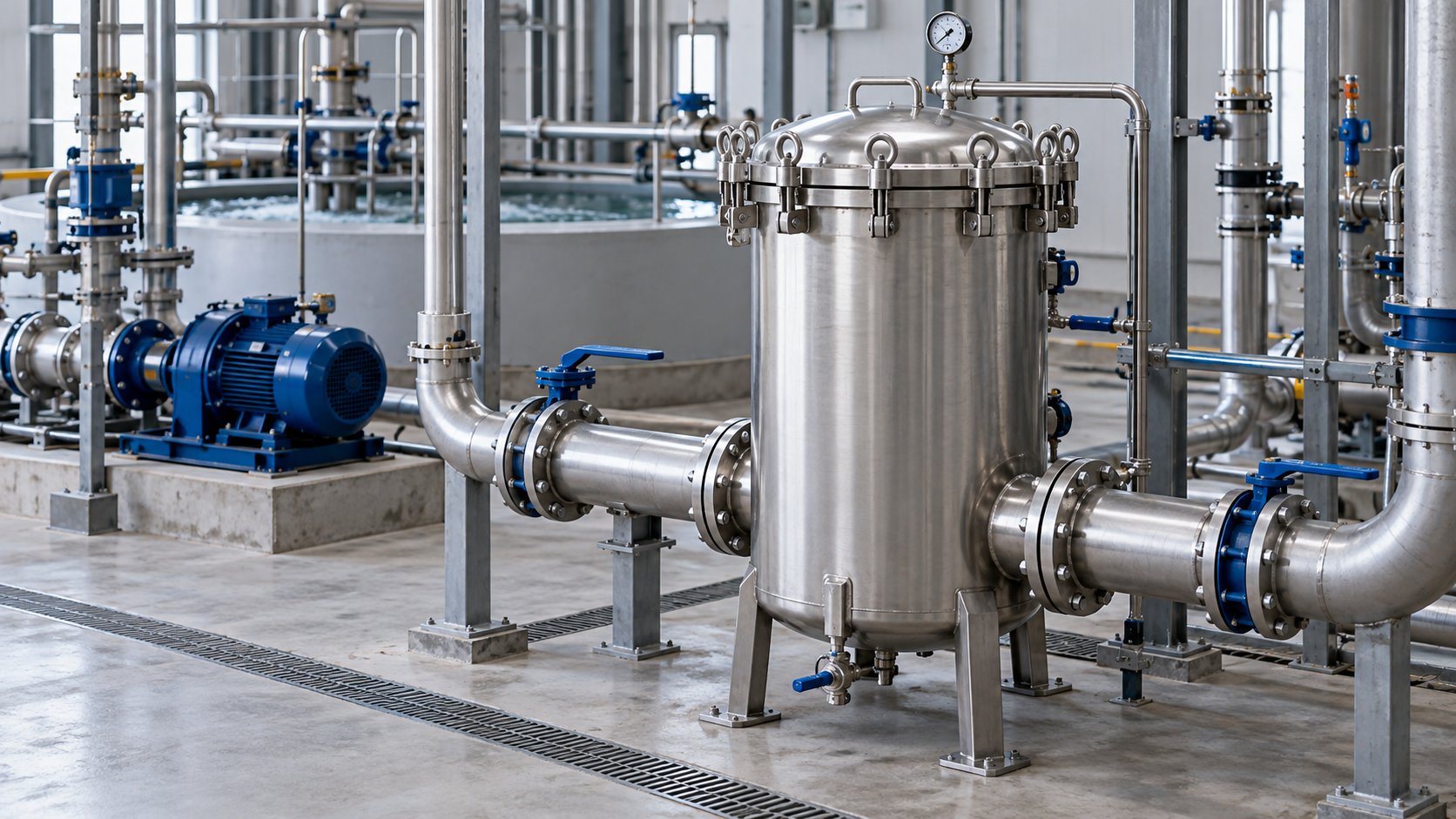
A multi-bag filter is an option to evaluate when several filter bags need to work in parallel, but high flow alone is not enough to select a housing. Liquid properties, particle load, bag specifications, working pressure, maintenance requirements and opening clearance must be reviewed together. A product range's stated capability does not replace assessment of the actual operating conditions.
Consider both normal throughput and peak demand, including changes in liquid quality. Increasing the number of bags does not necessarily prevent frequent blockage if particle loading and effective filtration area have been overlooked. A housing may also be difficult to maintain if the installation leaves insufficient space for bag removal.
1. Six checks before selecting a multi-bag filter
| Item | Information to confirm | How it affects selection |
|---|---|---|
| Design flow | Normal flow, peak flow, units and variation | Supports assessment of equipment size against the actual duty |
| Liquid and contaminants | Liquid type, particle characteristics, loading and quality changes | Affects bag material, filtration rating and maintenance frequency |
| Bag quantity and type | Quantity, dimensions, basket and sealing arrangement | Must match the housing's internal construction |
| Pressure and temperature | Normal and peak conditions | Must be checked against housing, seal and bag data |
| Continuous operation | Whether shutdown is possible and whether standby or bypass arrangements are needed | Determines operating and maintenance planning |
| Installation space | Height, opening clearance, bag removal, lifting access and operator routes | Prevents maintenance difficulties after installation |
Provide the units and operating context with each value. A peak flow and a normal operating flow describe different conditions, and both should be identified during the technical discussion.
2. More bags do not automatically improve filtration results
Parallel bags allow several media elements to participate in filtration. However, load per bag, flow distribution, pressure loss, media rating and contaminant loading still need to be assessed for the specific housing model.
Provide the target flow and details of the existing installation. Confirm maximum flow and permitted operating conditions using the manufacturer's documentation rather than assuming that bag quantity establishes capacity on its own.
For a liquid containing a high solids load or material that forms sticky deposits, discuss pretreatment, media selection and replacement frequency. Increasing bag quantity should not be the only response to those conditions.
3. Review performance after commissioning
Record flow, inlet and outlet pressures, media replacement times and outlet quality during operation. If flow falls or filtration performance changes, first check pump and valve conditions, bag installation, changes in the incoming liquid and the instruments. Use the findings before deciding whether to change the equipment configuration.
Before opening the housing for maintenance, stop, isolate, depressurize and drain the system according to the equipment instructions.
4. Check flow distribution as well as total flow
With several bags working in parallel, confirming total flow is only part of the review. Check that the internal design, bag model and actual operating conditions agree with the supplier's documentation.
Uneven inlet flow can contribute to differences in the loading of individual bags. Operating data and the condition of removed bags can help identify whether this is occurring. Do not increase pump pressure without assessment to compensate for inadequate flow.
Keep bag inspection findings linked to operating records. This gives the supplier and process team more useful evidence than a total flow reading without information about the media or inlet conditions.
5. Confirm maintenance access before installation
Check whether beams or columns obstruct the lid's opening direction, whether bags can be removed completely, whether operators have a safe position for dismantling and whether liquid can be drained conveniently.
Where space is limited, give equipment outline drawings and the planned maintenance movements to installation and production personnel for review before installation. Identifying a clearance problem while reviewing the layout is more practical than discovering it during the first bag change.
6. Guangxiangyu Tech multi-bag filter products
Shenzhen Guangxiangyu Technology Co., Ltd. was established in 2009 and is based in Longgang District, Shenzhen. We supply industrial liquid filtration equipment and water treatment cartridges.
Our range includes multi-bag filter housings and compatible bags, as well as single-bag, quick-opening bag filter and cartridge filter housings. Confirm the multi-bag model, quantity and media configuration using the actual flow, liquid, contaminants and maintenance space. A parameter on one product page does not replace technical confirmation.
Explore our multi-bag filter housings, filter bags and product range. Send piping photos, design flow, pressure, temperature, liquid and contaminant information, and opening-clearance details to Liu Nan, Sales Manager at LiuNan2553@gmail.com.
7. Frequently asked questions
How is the number of bags selected from the flow rate? Assess the housing model, effective bag area, particle load and manufacturer's design data together. Do not apply a fixed bag count based on flow alone.
Can bags be changed without stopping the process? Online maintenance depends on the system's isolation or standby arrangements and the specific equipment construction. Establish this requirement during selection.