
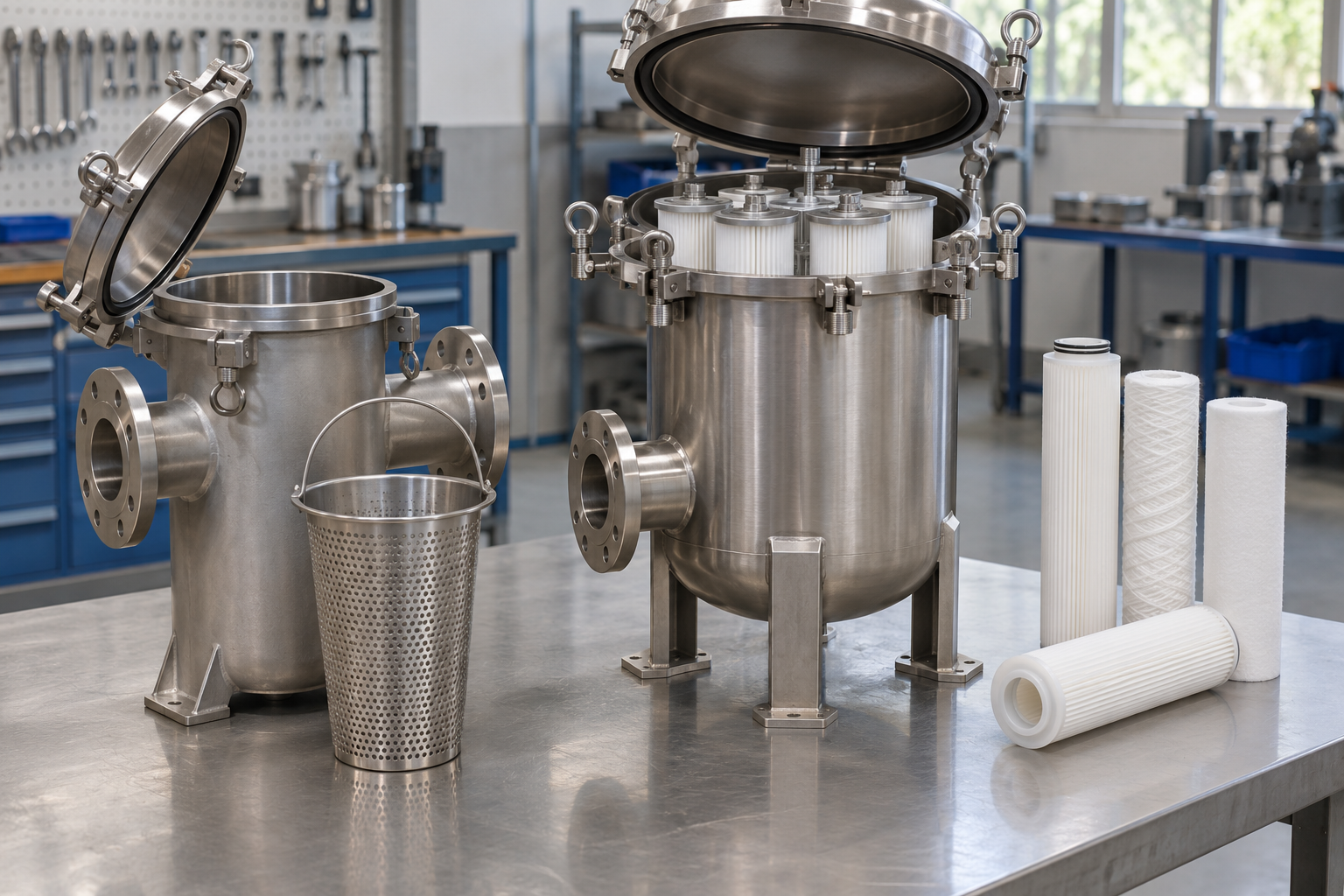
Cartridge count should not be chosen from pipe diameter or a single nominal flow figure. Size the filter using the required total and peak flow, the exact cartridge model and effective area, liquid properties, allowable pressure drop and downstream requirements. Data for one cartridge size or product cannot automatically be applied to another.
Confirm the design inputs
Gather normal and peak flow, liquid viscosity and temperature, operating pattern, target particles and filtration requirement. Provide the cartridge length, connection style and product data. Clarify whether the flow is continuous or a short peak, and whether the system needs a standby housing or changeover arrangement. A pump's rated capacity does not necessarily represent the filter's actual operating point.
Ask for the calculation assumptions
Have the equipment supplier identify the cartridge model and quantity, the conditions used for each cartridge, total effective area, expected pressure-drop range and maintenance assumptions. Check the available space inside the housing, flow distribution, seals and pressure rating. If cartridge count is increased, also review housing dimensions, pipework and maintenance access rather than comparing cartridge cost alone.
Parker's filter-sizing guidance uses application data such as operating viscosity, flow and the required cartridge housing capacity. This illustrates why cartridge count needs to be calculated for the selected product and fluid rather than taken from a universal rule.
Include normal and peak conditions in the proposal
For applications with variable peak flow or viscosity, request separate assumptions for normal and peak operation, along with the cartridge model and number, housing arrangement and expected maintenance limits. If an existing system is available, share actual flow, pressure readings, cartridge replacement intervals and changes in the process liquid. An engineer should check the proposed calculation against the manufacturer's product data; review the assumptions against field measurements after commissioning.
Check each cartridge's operating conditions
When calculating total flow, consider cartridge length and construction, recommended flow conditions, liquid viscosity and particle loading. Do not divide the target flow by a generic per-cartridge number. Ask the supplier to state the calculation basis, design margin and pressure-drop limits, and confirm that the housing connections and cartridge configuration match. Final sizing should follow the equipment documentation and project requirements.
Precision filtration inquiries
Shenzhen Guangxiangyu Technology Co., Ltd., established in 2009 in Longgang District, Shenzhen, supplies precision filter housings, cartridges and compatible bag filtration equipment. To discuss cartridge quantity, share the flow profile, process liquid conditions, cartridge data and housing details with Liu Nan, Sales Manager, at LiuNan2553@gmail.com. Final sizing should be confirmed by the project engineer or equipment owner using the selected product specifications.
See our precision filters, filter cartridges, or contact page.
Technical reference
- Parker, Industrial Filtration Products Catalog. Its sizing example considers operating viscosity, cartridge flow data and the number of cartridges that fit the selected housing; use the current specifications for the actual product.