
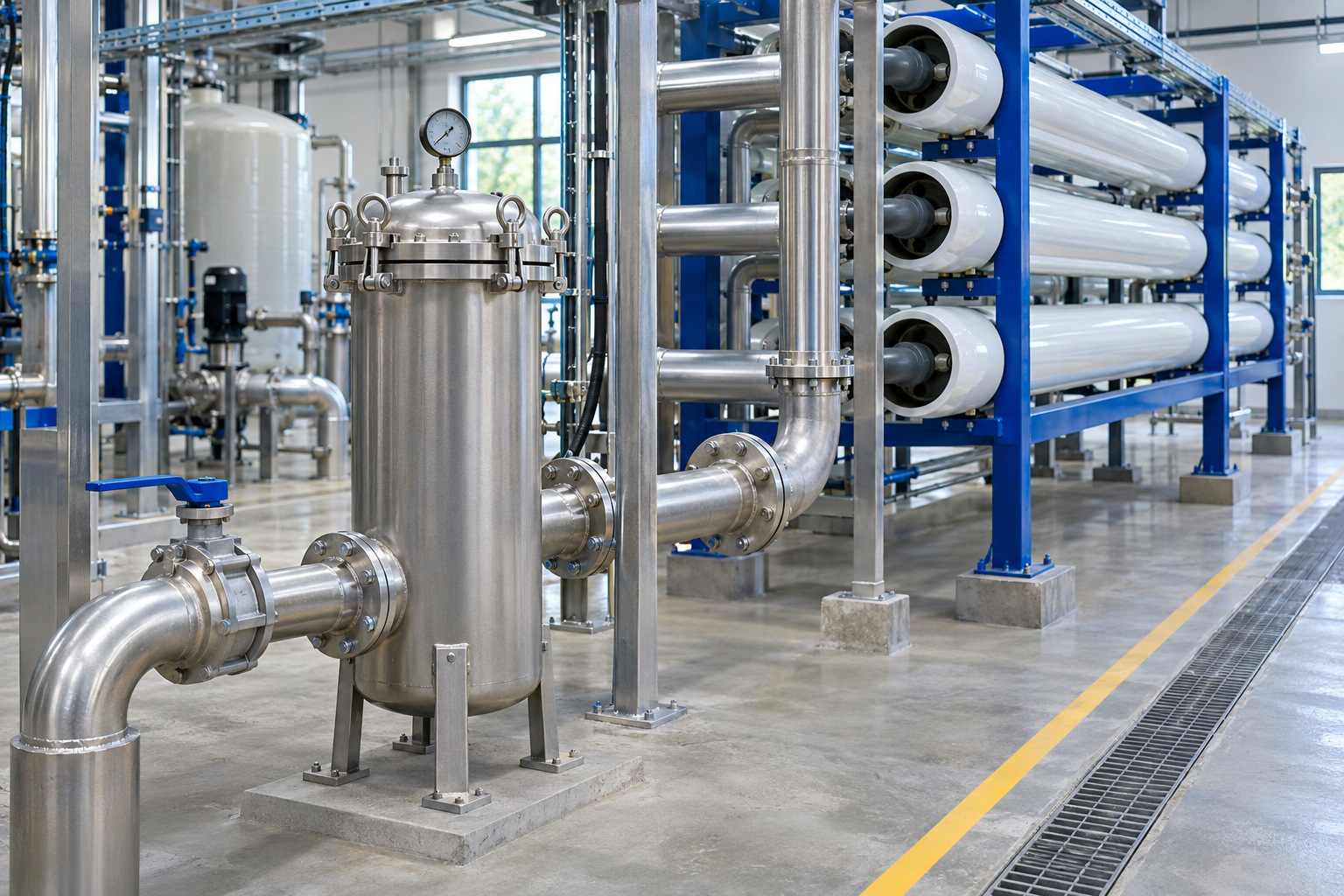
One role of pretreatment filtration is to capture suspended particles that the selected media can retain and reduce the particle load reaching downstream equipment. That alone does not remove dissolved salts or guarantee that an RO system will avoid scaling, organic fouling or biological fouling. Check feedwater limits in the documentation for the specific membrane and system design.
Identify what the pretreatment is intended to control
Record the source of particles in the raw water, changes in turbidity or suspended solids, the existing pretreatment steps, flow and operating pattern. Assess bag filters, precision cartridges or staged filtration against particle size, loading and downstream requirements. Confirm how a media rating is defined and tested; a micron figure by itself does not establish how well an RO membrane will be protected.
Check the membrane system's feed requirements
RO feed may also need to meet requirements for indicators such as silt density index (SDI), residual chlorine, temperature, pH, hardness or other water-quality parameters. The applicable ranges depend on the membrane model, pretreatment train and project documents. DuPont's FilmTec technical manual, for example, treats feedwater quality and pretreatment as a set of membrane-specific considerations. A particle filter is one process unit; it does not replace designed softening, dechlorination, disinfection or antiscalant treatment.
If operating conditions become abnormal, have the membrane supplier and process team review the data together. Replacing the cartridge with a finer grade may not address the cause and can affect flow and pressure drop.
Do not turn particle capture into a membrane performance guarantee
Pretreatment filtration can reduce particle loading within the selected rating and operating conditions. That does not demonstrate that RO feedwater meets every required parameter. Review the RO supplier's feedwater limits, the complete pretreatment configuration and the water-quality test plan. State the filter's duty, monitoring method and replacement basis clearly. Any performance commitment should be tied to defined test conditions and responsibilities.
Review changes across the whole pretreatment train
Track changes in upstream particle loading and RO feedwater quality together. If contamination risk remains after the prefilter, check other pretreatment units, system integrity and sampling results under the approved design. Do not assume that progressively finer filter media will solve every feedwater problem. Before changing a component, confirm allowable pressure drop and operating conditions with the system supplier.
Industrial filtration equipment inquiries
Shenzhen Guangxiangyu Technology Co., Ltd., established in 2009 in Longgang District, Shenzhen, supplies precision filter housings, cartridges, bag filter housings and filter bags for industrial liquid filtration. For a particle-control discussion, share available water-quality data, the pretreatment arrangement and the RO system's feed requirements with Liu Nan, Sales Manager, at LiuNan2553@gmail.com. Membrane limits, process design and acceptance requirements should be confirmed from the project documents and membrane supplier.
See our precision filters, filter cartridges, or contact page.
Technical reference
- DuPont FilmTec Reverse Osmosis/Nanofiltration Membranes Technical Manual. The manual discusses feedwater quality, pretreatment, system design and operating limits for FilmTec membrane systems; use the instructions for the actual membrane and project.