
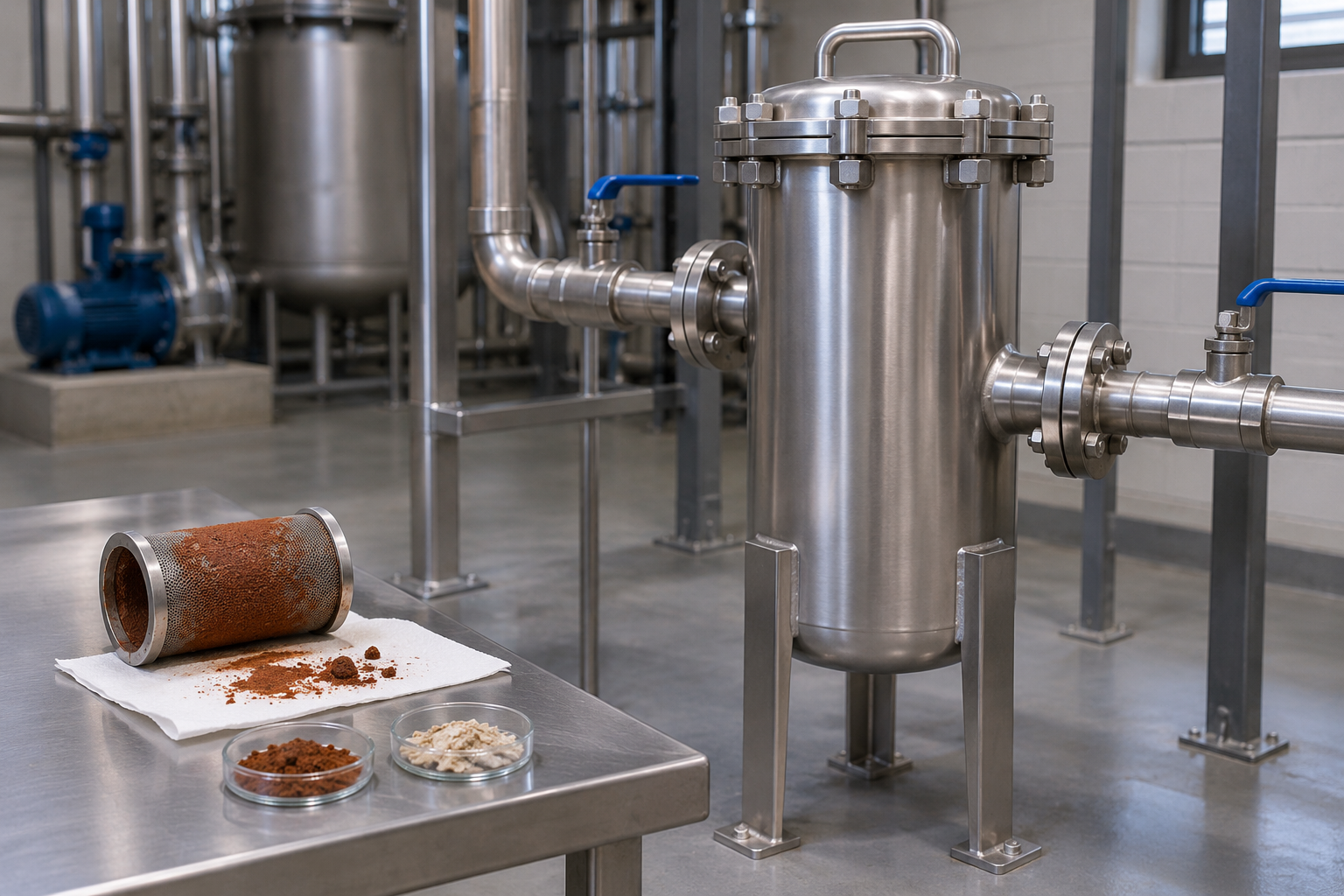
A red-brown or dark deposit on a filter element does not, by itself, prove that the housing is corroding. Material may come from upstream pipework, process deposits, incoming particles or a local change in equipment condition. Record where it appears and how the system was operating, then use material information and suitable inspection or analysis to establish the source.
Record where the deposit appears
Note whether the material is spread across the filter bag or cartridge, or concentrated near a weld, connection, support basket or part of the housing. Record the operating time, process liquid, temperature, cleaning agents, shutdown period and recent pipework or maintenance changes. Photograph the filter media and relevant equipment from identifiable locations. Handle and retain samples only in line with site procedures for the process liquid and residue.
Inspect the filter and upstream system together
Review material records for the housing and wetted components, then inspect the upstream tank, pipes, pump and valves for signs of corrosion, wear or cleaning residue. A deposit concentrated at one location may warrant a closer assessment of local wear, crevices or material compatibility. A process or materials specialist can determine whether water, liquid or deposit sampling and laboratory analysis are appropriate.
Do not apply an unverified acid, alkali or rust remover to the housing. Once the source is better understood, the responsible engineering team can consider whether the process needs pre-filtration, a material change, pipework repair or another corrective measure. Ordinary particle filtration can capture particles within the selected media's capability; it does not remove an ongoing source of corrosion.
Use sampling and material records to narrow the cause
If deposits recur or could affect product quality, document their location and collect representative samples using an approved method. Compare findings from the housing and filter media with the equipment material records, process liquid and upstream inspection. The US EPA's water-treatment guidance describes sampling and analysis as tools for investigating deposits in water systems; the appropriate method depends on the actual liquid and question being investigated. Colour alone is not enough to identify the material or determine whether a component has corroded.
Before cleaning, grinding or replacing a component, confirm that the proposed method is compatible with its material and will not damage its surface or introduce contamination. The equipment owner or materials specialist should approve the inspection and repair plan.
Information useful for a product inquiry
Shenzhen Guangxiangyu Technology Co., Ltd., established in 2009 in Longgang District, Shenzhen, supplies industrial liquid filtration equipment and water-treatment filter elements, including stainless steel filter housings, filter bags and cartridges. For a product inquiry, share the equipment material information, photographs of the deposits and connected pipework, and available process records with Liu Nan, Sales Manager, at LiuNan2553@gmail.com. Corrosion diagnosis and repair decisions should be made by the responsible technical personnel.
See our bag filter housings, filter bags, or contact page.
Technical reference
- US EPA, Technologies for Upgrading Existing or Designing New Drinking Water Treatment Facilities. The document discusses sampling and chemical analysis in drinking-water treatment systems; it is a reference for the value of investigation, not a diagnosis for every industrial process.