
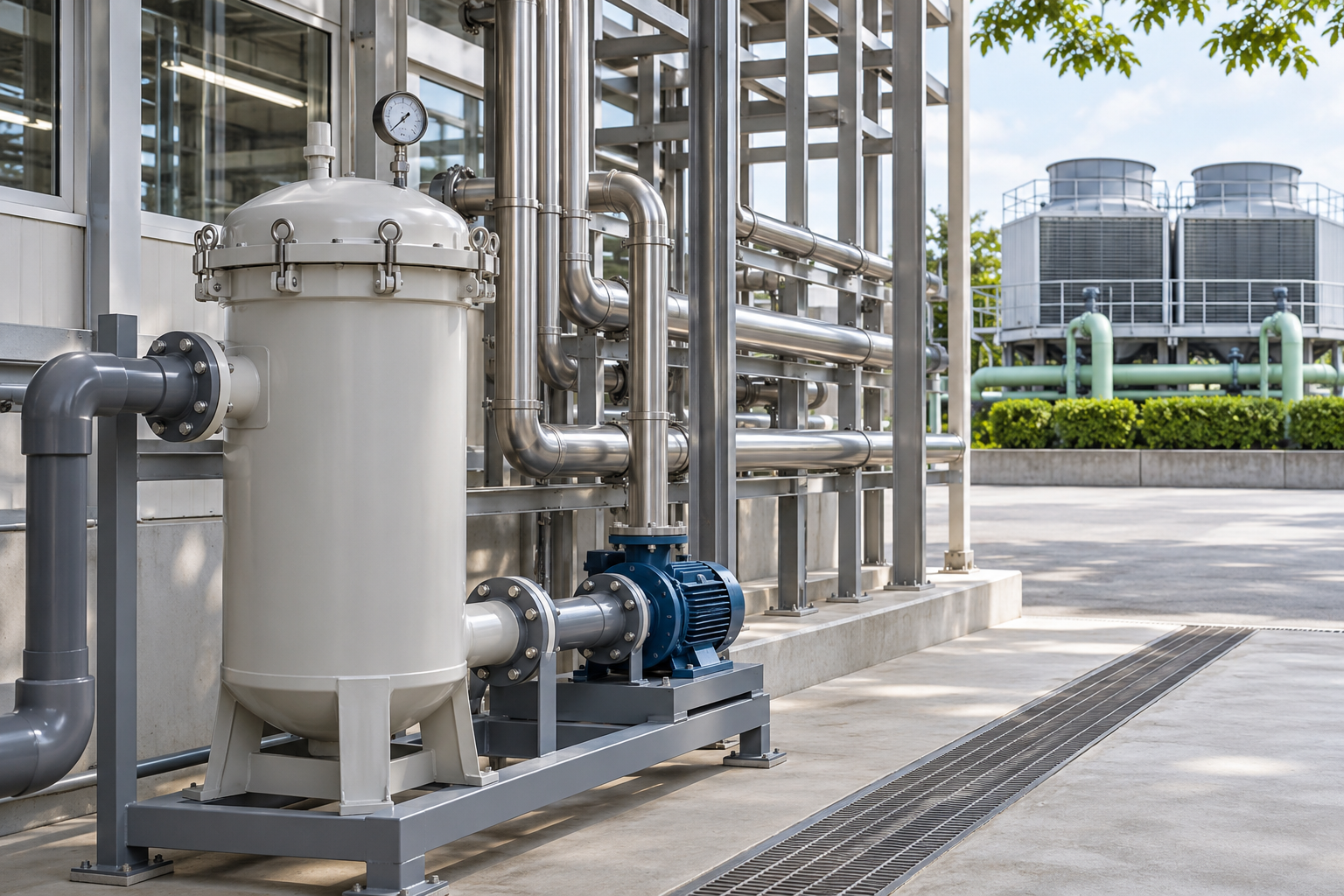
Particle loading and maintenance needs in a cooling-water system can change with make-up water, operating load, shutdowns and cleaning. Plan filter selection and inspection around the system's water quality, target particles, flow, temperature, operating schedule and maintenance windows. A fixed month or replacement ratio alone cannot describe every cooling system.
Identify what is changing in the water
Record changes in the make-up water source, pipework work, basin cleaning, visible biological material or corrosion products, production load and circulation-pump operation. Rainfall, evaporation and seasonal shutdowns may affect the operating conditions, but the actual effect should be checked against water-quality and system records. If the concern is hardness, scale or biological control, particle filtration alone is not a complete treatment; have the water-treatment specialist assess the required measures.
ASHRAE notes that evaporation in cooling towers can increase the concentration of dissolved solids and other impurities in circulating water. That is one reason to track water chemistry and operating conditions alongside the filter record. A particle filter does not by itself control dissolved salts, scale chemistry or biological growth.
Keep comparable records across seasons
Use consistent sampling points and observation methods before and after filtration. Record flow, filter differential pressure or operating condition, media replacements and cleaning. Note the media model and batch after each change, and log changes to make-up water, chemical treatment or cleaning. Comparing these records across seasons can help distinguish a change in particle loading from a change elsewhere in the water-treatment process.
Use seasonal trends to plan inspections
Organise make-up-water data, water-quality results, filter maintenance and collected material by month or operating period. If clogging increases during a particular period, first check whether particle sources, filter flow or water-treatment practices changed. Use the trend to plan when to inspect more closely; do not assume that a specific fault will occur every year in a particular month.
Consider make-up water and operating load together
Water temperature, evaporation, make-up source and maintenance schedules may all vary during the year. Review filtration records alongside make-up volume, blowdown, system load and the timing of water-quality tests. This makes it easier to distinguish particle loading from scale, corrosion or media issues. Where treatment chemicals are involved, the system's water-treatment specialist should review them in the context of the complete programme.
Cooling-water filtration equipment inquiries
Shenzhen Guangxiangyu Technology Co., Ltd., established in 2009 in Longgang District, Shenzhen, supplies industrial liquid filtration equipment and water-treatment filter elements, including bag filter housings, precision filters, filter bags and cartridges. For a cooling-water particle-filtration inquiry, share water-quality and operating records, flow, the target particles and maintenance history with Liu Nan, Sales Manager, at LiuNan2553@gmail.com. Filtration equipment supports particle control and does not replace a complete cooling-water management programme.
See our bag filter housings, precision filters, or contact page.
Technical reference
- ASHRAE Handbook, Chapter 40: Cooling Towers. The chapter discusses evaporative concentration of dissolved solids and other impurities in cooling-tower water; water treatment requirements depend on the system.