
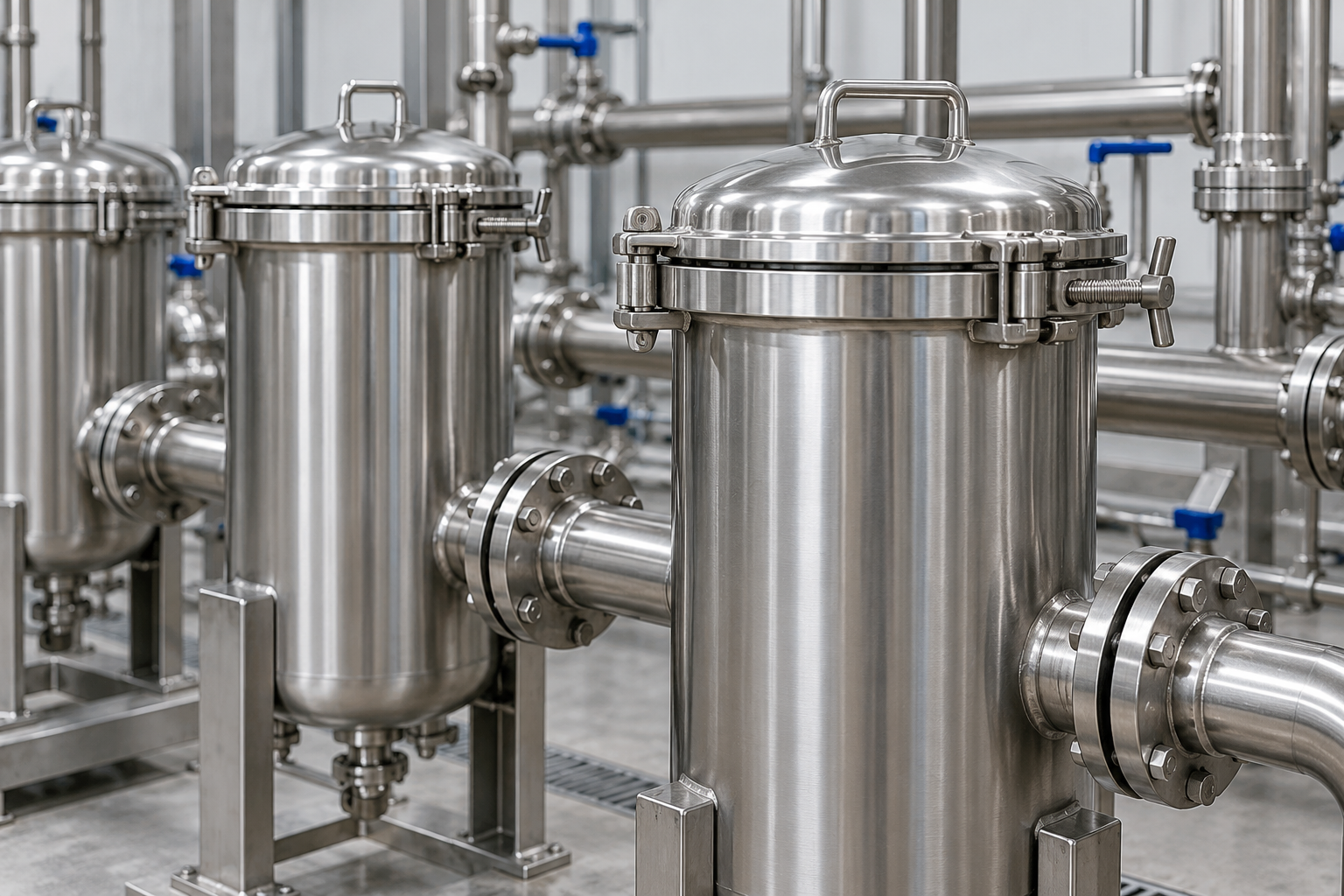
A stainless steel grade cannot be selected reliably from a broad label such as “water,” “acid” or an industry name alone. The liquid’s composition, concentration, temperature, additives, cleaning regime and contact time all matter. The installation environment, design details and condition of the wetted parts also affect material suitability.
Grades such as 304 and 316L are starting points for a specification, not a universal corrosion guarantee. Outokumpu’s stainless steel guidance notes that corrosion behaviour can depend on chemical environment, pH, temperature, surface finish, product design, fabrication and maintenance. Its guidance also explains that chloride-bearing environments can present localized corrosion concerns. Those factors should be reviewed for the actual service conditions.
Describe the full operating environment
Before requesting a housing quotation, provide the known liquid composition or analysis, concentration range, normal and peak temperature, operating duration and cleaning chemicals. Include process additives and possible carryover from upstream stages. If the exact formulation is confidential, agree with the supplier what information can be shared for an initial compatibility review.
Also describe the surrounding environment. Outdoor salt exposure, persistent moisture, deposits, stagnant liquid and areas around welds or insulation can create conditions that differ from the bulk liquid. State whether the filter will be drained or left filled during shutdown and how often it will be washed or inspected.
| Information to provide | What to confirm |
|---|---|
| Liquid composition and concentration | Include relevant contaminants, additives and cleaning solutions |
| Temperature and contact time | Include normal, peak, start-up and cleaning conditions |
| Operating and shutdown pattern | Clarify whether liquid remains in the housing between runs |
| Site environment | Note humidity, salt exposure, deposits, insulation and washdown |
| Process requirements | Identify contamination limits, inspection needs and records |
Do not choose by grade number alone
304 and 316L have different alloy compositions, but a grade number by itself does not decide whether a complete filter assembly is suitable. Review the actual service chemistry and design with the responsible materials or process engineer. A material selection made for one concentration or temperature may not apply to a different mixture, cleaning step or operating cycle.
Ask the supplier to identify the material grade for the pressure-retaining shell and for every wetted component. These may include the basket, cover, fasteners, nozzles and other internals. Request material certificates or product documentation when required by the application, and have the design or process owner review the evidence.
For critical or uncertain service, published corrosion tables can support preliminary screening, but they do not replace review of the actual equipment design and conditions. A controlled compatibility review or representative evaluation may be appropriate before committing to a production installation.
Check seals, filter media and connections too
The shell is only one part of the fluid-contact system. Filter bags or cartridges, elastomer seals, coatings, lining, fasteners and connection components may have different compatibility limits. Confirm the relevant material and operating range for each part that touches the liquid.
Upgrading the housing grade cannot compensate for an unsuitable seal or filter medium. Compatibility, filtration performance and pressure or temperature limits should be checked together against the complete assembly and the manufacturer’s data.
Bag and cartridge filter products
Shenzhen Guangxiangyu Technology Co., Ltd. supplies stainless steel bag filter housings, precision filter housings and compatible filter media. For a request involving a special liquid, provide the liquid conditions and a list of wetted parts so the proposed configuration can be reviewed against its product documentation. This article does not certify any grade for a particular chemical service.
See our bag filter housings, precision filters and filter cartridges. Contact Liu Nan, Sales Manager, at LiuNan2553@gmail.com.
Technical reference
Outokumpu: What Makes Stainless Steel Corrosion Resistant? and Outokumpu corrosion tables. Use material-specific technical data and qualified engineering review for the actual chemical composition, concentration, temperature and design.