
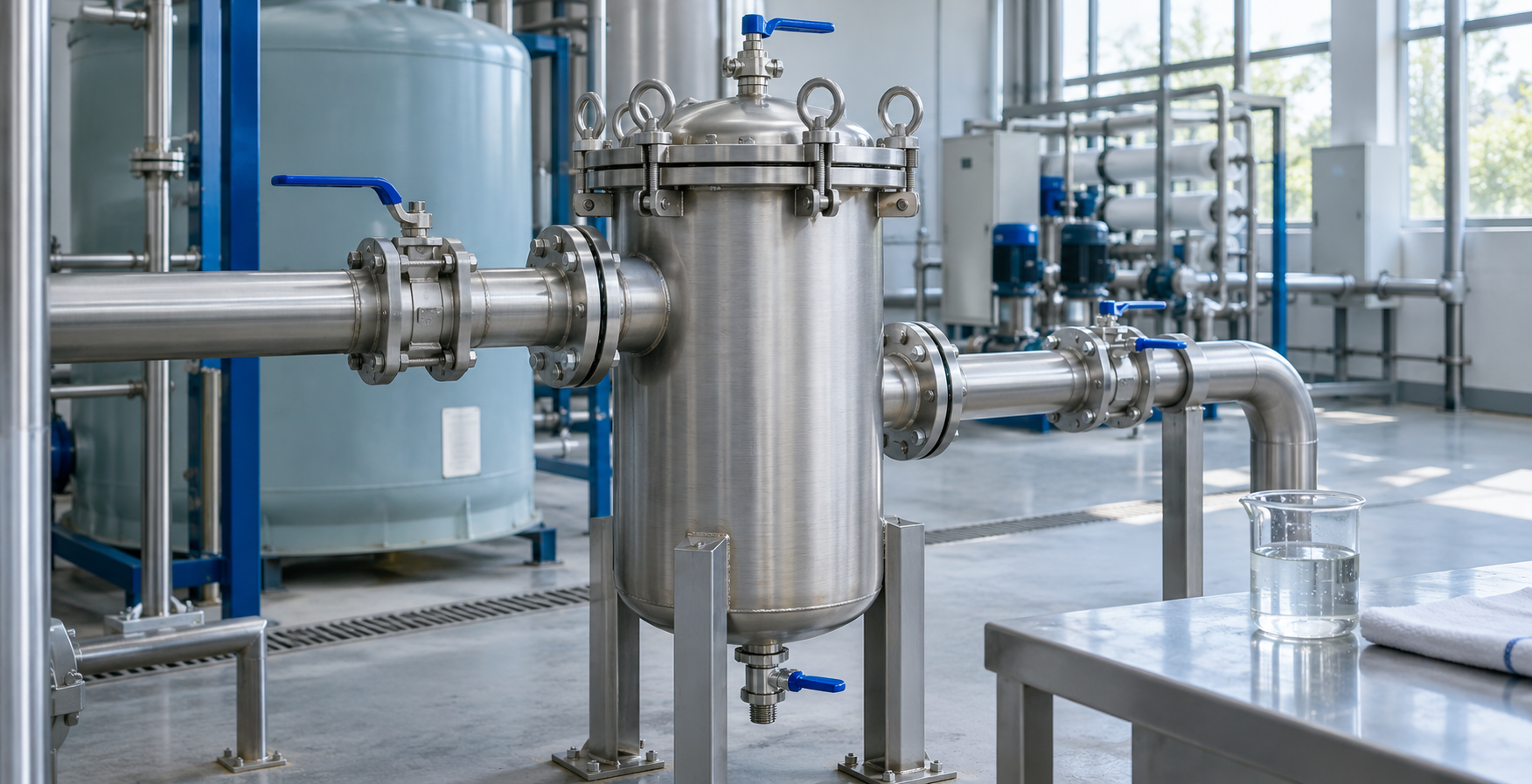
Do not select a production-water filter from appearance alone. First define how the well water will be used, the downstream equipment’s water-quality limits and the process objective. Then choose sampling and laboratory analyses that match those requirements. A bag filter or precision cartridge can address particles within its design; it does not replace softening, iron or manganese treatment, or disinfection where those processes are required.
Define the use and the operating pattern
The information needed for cooling water, equipment washing, process make-up or reverse-osmosis pretreatment can differ. Confirm whether the water contacts a product, identify the downstream equipment and its feed-water requirements, and note any reuse or discharge criteria that apply to the project.
Record the well location, sampling time, pumping duration and relevant recent changes such as heavy rainfall, maintenance or a change in production demand. Water quality can vary with season and pumping conditions, so one sample may not represent every operating period. Ask the laboratory or responsible process professional whether repeat samples or different sampling times are needed.
Match the analysis to the problem you need to solve
For a particle-removal objective, the team may need suspended-solids, turbidity, particle-size or settling information. Depending on the source and downstream use, other analyses—such as iron, manganese, hardness, pH or microbiological indicators—may also be relevant. Select the test method and reporting units with the laboratory and the people responsible for the process. Drinking-water guidance for private wells can help identify possible concerns, but it does not define industrial process-water requirements; follow the applicable local rules and equipment specifications.
Separate particulate filtration from dissolved-water treatment. Sediment or rust particles may be evaluated with a screen, bag filter or precision cartridge based on particle characteristics, flow and loading. Dissolved iron or manganese, hardness, or a microbiological objective may require a separate process such as oxidation, softening or disinfection. A finer bag rating alone should not be assumed to meet those objectives.
Turn the report into a filtration discussion
Compare each result with the intended use and the downstream equipment’s limits. Mark which results represent normal conditions and which may be short-term peaks. If the particle load changes during pumping or across seasons, provide the range or arrange representative sampling rather than sizing from a single concentration.
Share the water report with the flow, pressure, temperature, operating schedule and existing treatment steps. Housing size and media selection depend on the combined duty, not a single lab result. If a result points to dissolved constituents or another non-particle target, have that treatment step assessed separately by the responsible water-treatment professional.
Filtration products and inquiries
Shenzhen Guangxiangyu Technology Co., Ltd. supplies bag filter housings, precision filters, filter bags and cartridges. For a production-water prefiltration discussion, share the water-quality report, intended use, flow, pressure, temperature and downstream equipment requirements with Liu Nan, Sales Manager, at LiuNan2553@gmail.com. Confirm water-treatment design and acceptance criteria with the appropriate laboratory and project professionals.
See our bag filter housings and precision filters, or contact us with the operating details.
Technical reference
US EPA: Protect Your Home’s Water. This page concerns private wells and drinking-water testing; production-water analyses should be selected for the intended process and applicable local requirements.