
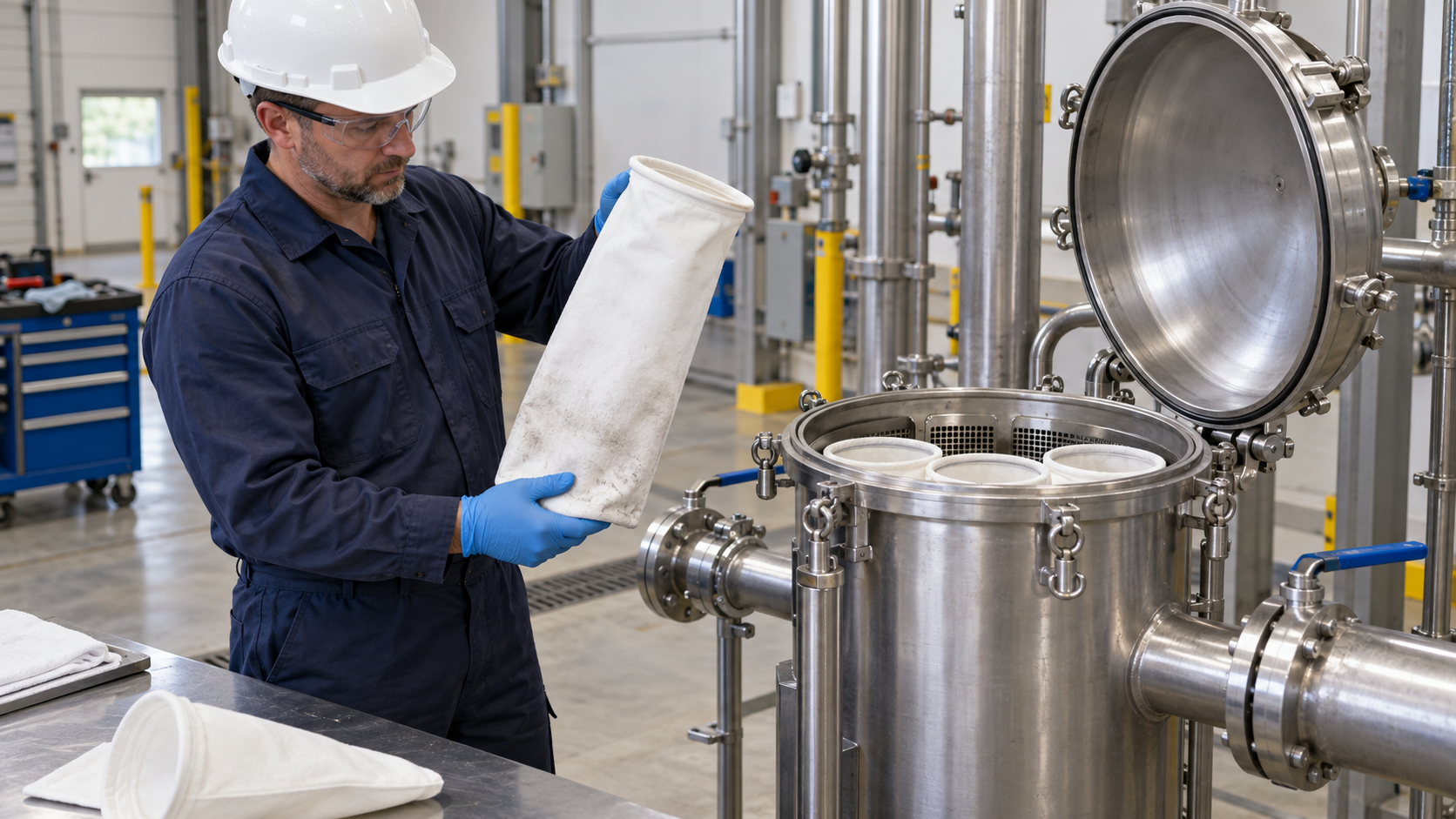
There is no fixed number of days between filter bag changes that suits every application. Incoming particle load, flow, bag area and construction, filtration rating and operating time all affect service life. A more reliable approach is to record operating conditions and performance after each change, then schedule maintenance using the equipment limits, outlet quality requirements and inspection findings.
Replacing a bag every week by calendar alone may waste consumables when loading is low, or leave replacement too late when loading suddenly increases. Your own operating records help the maintenance team see whether service life is changing gradually or following a change in water quality, flow or a production step.
1. Six details to record for each filter bag
| Record | Information to include | Why it helps |
|---|---|---|
| Installation time | Date, shift and operator | Establishes the actual operating time |
| Bag identification | Model, material, stated filtration rating and batch | Distinguishes differences between media models or batches |
| Operating conditions | Flow, temperature and continuous or intermittent operation | Allows comparison under different loads |
| Pressure readings | Inlet and outlet pressure, including measurement units | Shows trends; operating limits must come from the equipment data |
| Outlet quality | Appearance, test results and sampling location | Indicates whether the actual filtration objective is being met |
| Removed bag inspection | Blockage location, tears, deformation and foreign material | Provides evidence for the next selection or operating adjustment |
Connect the readings and inspection notes to the particular bag installed. Without its model, installation time and operating conditions, a replacement date alone provides little information about why the bag needed changing.
2. Conditions that need prompt investigation
If the differential pressure trend changes, flow falls enough to affect production or the outlet no longer meets process requirements, compare the observations with the operating conditions specified for the equipment and media. Follow the site's procedures to decide whether to stop, inspect or replace the bag.
If bags repeatedly block quickly, review upstream particle loading, processing flow, filtration area and the selected rating. If a bag develops holes or localized damage, also check liquid compatibility, collar sealing, basket support and installation practices.
These findings should guide the investigation. Short service life does not, by itself, establish that the bag rating or material is wrong. Review the operating records alongside the condition of the removed bag before deciding on a change.
3. Follow the equipment procedure during replacement
Stop the pump, isolate the housing and confirm that pressure has been released and the vessel drained before opening it. Follow the equipment instructions for the complete replacement procedure.
Do not copy differential pressure limits, replacement intervals or allowable flow from another housing model or an online article. The maintenance rule for your installation must remain within the limits specified for its equipment and consumables.
4. Build a maintenance rule from your workshop's history
Collect several complete replacement records before comparing the operating range of the same bag under similar liquid quality and flow conditions. If the time between changes varies widely, compare production steps, water-source changes, abnormal discharges, media batches and actual operating hours.
Use the comparison to identify variables associated with shorter service life. A practical rule can specify the site signals that trigger an inspection, while retaining the safety limits in the equipment manual. It should provide more guidance than an alarm that simply counts calendar days.
During the first run of a new bag, pay particular attention to installation, initial differential pressure and whether the outlet meets the process objective. Photograph the removed bag and record where blockage occurred. This can help distinguish a high overall load from a localized flow-path, collar or basket issue.
Replacement intervals become useful references only when the records can be connected to identifiable operating conditions.
5. Guangxiangyu Tech products and selection support
Shenzhen Guangxiangyu Technology Co., Ltd. was established in 2009 and is based in Longgang District, Shenzhen. We supply industrial liquid filtration equipment and water treatment cartridges.
Our range includes stainless steel single-bag, multi-bag and quick-opening bag filter housings, compatible filter bags, cartridge filter housings and replacement cartridges.
If replacement intervals remain unsatisfactory, collect the bag model, operating records, liquid-quality information and flow data before discussing whether the media specification or equipment configuration needs reviewing. Recommendations depend on the actual operating conditions and product data.
See our bag filter housings, filter bag range and maintenance guide. Send recent replacement records to Liu Nan, Sales Manager at LiuNan2553@gmail.com.
6. Frequently asked questions
How often should a filter bag be replaced? Use site records and the equipment requirements. One fixed replacement interval cannot be applied to every liquid quality and operating condition.
Can a filter bag be washed and reused? Check the media type, contamination and supplier instructions. An unverified cleaning method may damage the media or introduce cross-contamination.