
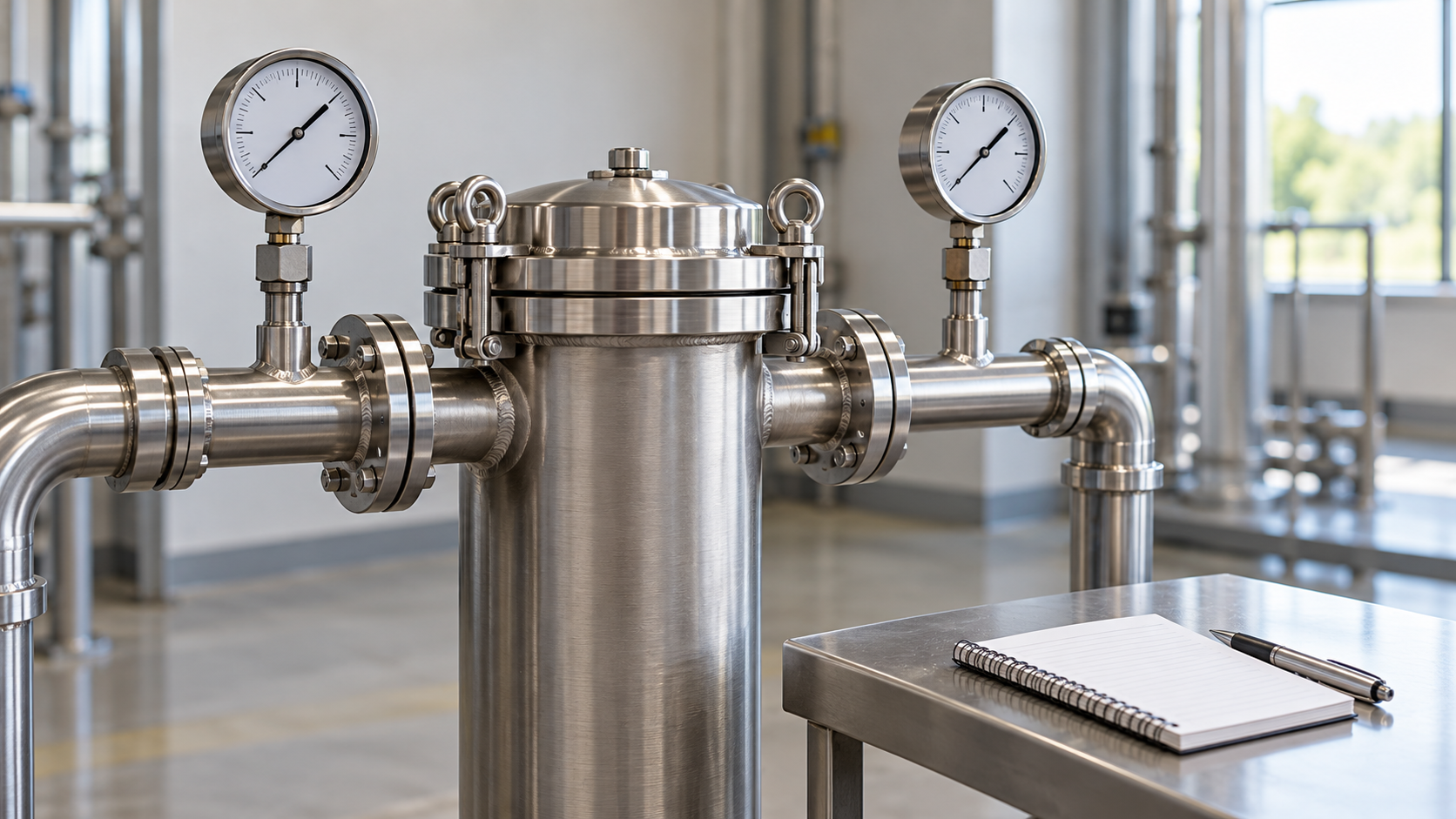
Filter pressure readings are most useful when they are compared with a recorded baseline under similar operating conditions. A rising pressure difference can prompt a maintenance investigation, but a single gauge reading does not establish that a cartridge is blocked or that the filtered liquid meets its quality target.
Start with the measurement points, units and equipment instructions. The pressure difference across one filter must be kept separate from pressure changes across a pump, membrane stage or an entire process line.
1. Confirm what the two gauges measure
For the same filter assembly, differential pressure is the inlet pressure minus the outlet pressure. Use matching units and readings taken at approximately the same time. Confirm the installed tapping points and whether intervening piping or valves are included in the measurement.
For illustration only, an inlet reading of 2.4 bar and an outlet reading of 2.1 bar give a difference of 0.3 bar. These are arithmetic examples, not recommended operating pressures or replacement thresholds.
If the outlet reading exceeds the inlet reading during expected forward flow, check instrument identification, units, gauge condition and system conditions. Do not convert an unexpected result into a maintenance decision without resolving the measurement.
2. Record a baseline with new, correctly installed media
After commissioning according to the equipment instructions, record conditions once operation is stable. A useful baseline includes more than the pressure difference:
| Record | Reason to include it |
|---|---|
| Date, time and filter identification | Links later readings to the correct assembly |
| Inlet pressure, outlet pressure and units | Preserves the original measurements |
| Flow rate | Helps compare readings at a similar duty |
| Liquid temperature and identity | Identifies changes in process conditions |
| Cartridge or bag model, rating and quantity | Shows which media configuration was installed |
| Pump setting and relevant valve positions | Records the operating arrangement |
| Instrument identification and calibration status | Supports interpretation of the measurements |
Keep the baseline with the maintenance record. Replacing media with a different construction or changing the process duty may require a new baseline rather than a direct comparison with the old one.
3. Compare readings under similar conditions
Pressure loss depends on the duty as well as the condition of the media. A higher flow or a change in liquid viscosity can change the pressure difference. A lower reading after a flow reduction does not establish that the media has recovered.
Compare the current flow, temperature and operating arrangement with the baseline before drawing a conclusion. Where conditions differ, record the difference and ask the equipment supplier how it should be interpreted. Keep any correction method specific to the equipment and liquid involved.
DuPont's FilmTec manual identifies pressure measurements across the cartridge filter as part of RO instrumentation and calls for records of pretreatment filter pressure drop. It also treats instrument accuracy and calibration as necessary for useful monitoring. These practices support a trend record; they do not supply a universal limit for every housing.
4. Investigate changes before choosing an action
A gradual increase under comparable conditions may be consistent with accumulated material. An abrupt change warrants a review of recent process events, feed changes and instrument condition. An unexpectedly low difference can also deserve attention, particularly if downstream particle measurements have changed.
Pressure data alone cannot prove retention efficiency, correct sealing or the absence of bypass. Keep the liquid-quality checks required by the process specification. Our RO prefilter guide explains why particle filtration and feedwater suitability require separate consideration.
5. Agree on limits before routine operation
Obtain the permitted operating pressure, temperature and differential pressure from the documentation for the complete assembly and installed media. Ask the supplier to define the applicable replacement criteria. A housing pressure rating and a cartridge differential-pressure limit describe different constraints.
Follow the site procedure for escalation and shutdown. Before opening the housing, isolate it, depressurize and drain it as instructed; never loosen a pressurized closure. Log the maintenance action and establish the post-change readings under stable conditions.
For a filter housing inquiry, send the process duty, media details and pressure record to Liu Nan, Sales Manager, at LiuNan2553@gmail.com.
Technical reference
DuPont FilmTec Reverse Osmosis Membranes Technical Manual, Sections 3.14.5 and 5.6.4. Use the instructions for your installed filter and instruments when setting operating and maintenance limits.