
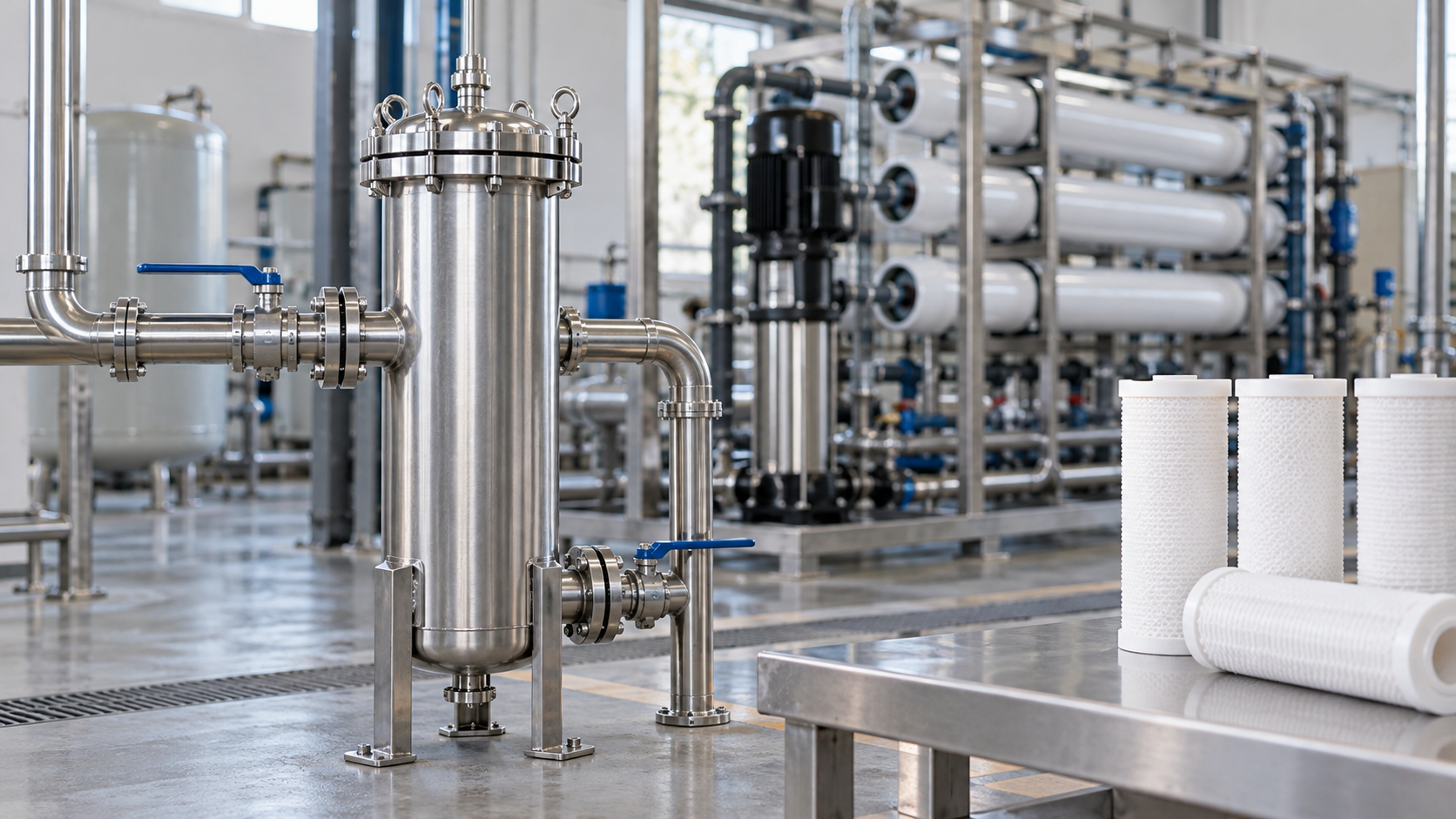
A cartridge prefilter before reverse osmosis helps control suspended particles. A standard particle cartridge does not remove dissolved salts or establish that the water is suitable for an RO system. Choosing this stage starts with a clear separation between the particles the cartridge is intended to retain and the other feedwater conditions the treatment system must address.
In its FilmTec technical manual, DuPont describes cartridge microfiltration as a protective stage for membranes and the high-pressure pump. The manual also explains that this filter is not intended to carry a large solids load. Those principles help define its role; the final specification must come from the supplier responsible for the particular membrane system.
1. Define the material you want to intercept
An inquiry that says only “RO prefilter” leaves several questions open. Is the concern sand carried from a storage tank, corrosion debris from piping, or particles escaping an upstream treatment stage? How much is present, and does the quantity change after a shutdown or a change in water source?
Ask for an analysis or a representative sample where the contamination is uncertain. Then agree on the cartridge's retention rating, the method behind that rating, and the operating conditions. A micron number by itself does not describe removal efficiency, service life or the suitability of all cartridge components.
| Feedwater concern | Question for the specification |
|---|---|
| Suspended particles | What particle sizes and loading must the selected media handle? |
| Dissolved salts or hardness | What separate treatment and membrane design address these constituents? |
| Chemical exposure | Are the cartridge, seals and housing compatible with the actual water chemistry? |
| Variable water quality | Which measurements trigger an investigation of the upstream treatment? |
2. Understand the limits of a standard particle cartridge
A polypropylene sediment cartridge works as a physical particle filter. It is not, by itself, a desalination stage, a softener or a chemical dosing system. Other media may have additional functions, but those functions need their own product documentation and acceptance criteria.
Do not infer that clear-looking water meets an RO feed specification. Dissolved constituents and other relevant water-quality parameters require appropriate measurements. Likewise, a sediment cartridge should not be treated as a validated disinfection process or as proof of microbiological safety.
The membrane or system supplier should identify the required feedwater analysis, allowable conditions and treatment responsibilities. A cartridge housing selection is one part of that specification.
3. Match the housing and cartridge to the operating duty
Prepare an inquiry containing normal and peak flow, water temperature, operating pressure, liquid chemistry, available pipe connections and space for changing cartridges. Include the specified cartridge dimensions, end connection, quantity and retention rating.
Ask the supplier to confirm wetted materials and seals, the clean-media pressure loss at the stated duty, and the operating and replacement limits for the proposed assembly. Confirm any documentation required by the installation location. Avoid assuming that a housing's appearance establishes its material grade or pressure capability.
See our cartridge filter housings for the product category, and read the cartridge material compatibility guide when assembling the inquiry.
4. Use maintenance observations to improve the specification
Record cartridge changes, pressure readings, flow and any water-source changes. If service life suddenly shortens, compare the new conditions with the earlier operating record before choosing a finer cartridge or increasing the number of cartridges.
During an approved shutdown, examination of used media can help frame questions about the contamination source. Follow the equipment instructions for isolation, depressurization and draining before opening the housing. Feedwater suitability still needs the measurements agreed with the membrane supplier.
Questions to settle before ordering
- Which particle-control requirement does this stage serve?
- Who defines the RO feedwater limits and the upstream treatment?
- Which media rating and complete cartridge construction are specified?
- What operating conditions and replacement criteria apply?
- How will the agreed filtration objective be checked?
For a cartridge housing inquiry, send these details to Liu Nan, Sales Manager, at LiuNan2553@gmail.com.
Technical reference
DuPont FilmTec Reverse Osmosis Membranes Technical Manual, particularly Section 2.5.7, Cartridge Microfiltration. Follow the instructions and specifications for your installed equipment; this article does not set a universal cartridge rating or replacement interval.