
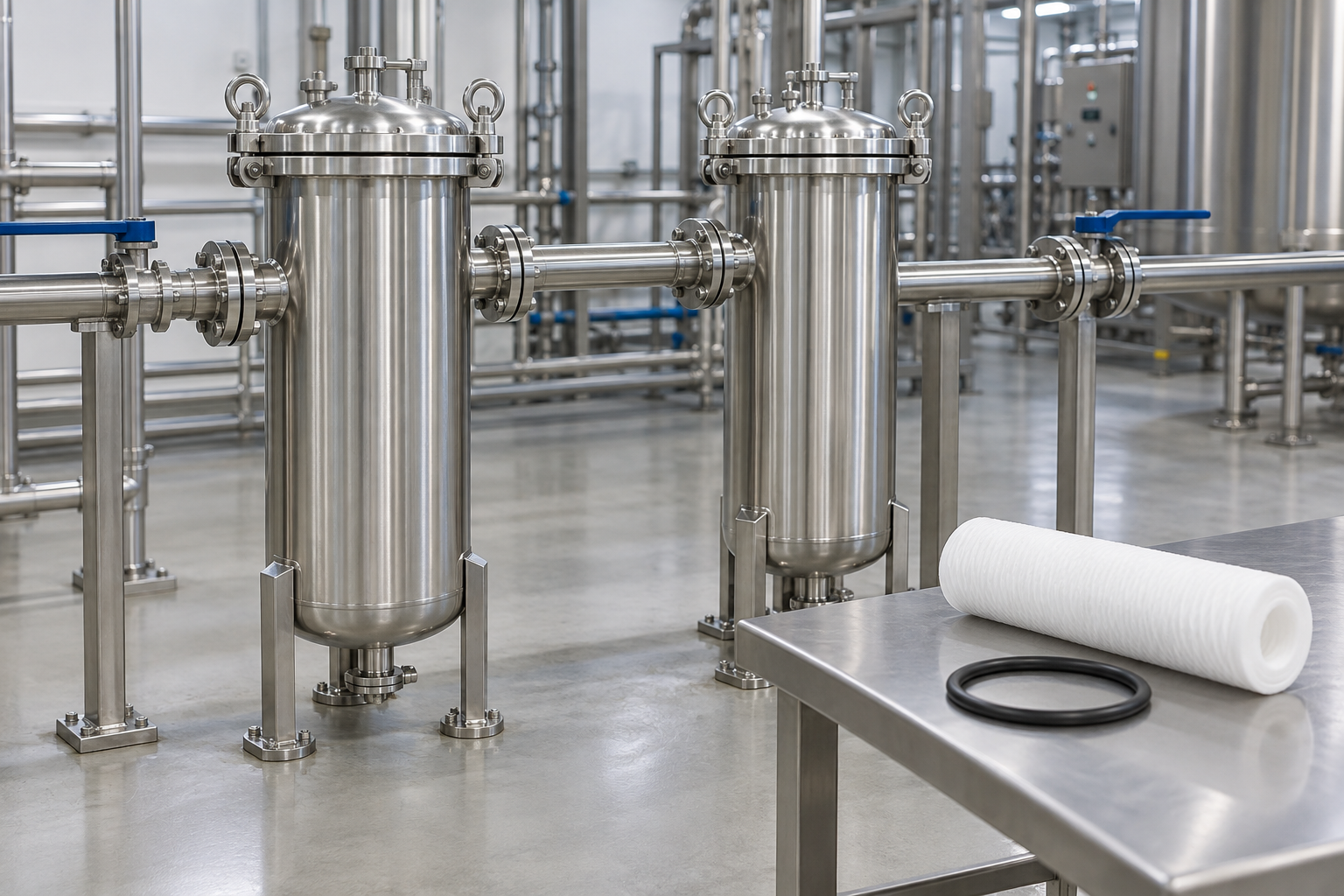
Selecting a filter bag or cartridge means checking every component that may contact the process liquid, including its seals. The media, stitching, end caps, core, support layers, O-rings and housing internals can have different material requirements. A suitable filter medium does not by itself confirm that a seal or other wetted part is compatible.
List all wetted components
Before requesting a replacement or quotation, identify the filter medium, stitching, bag collar or cartridge end cap, central core, support layers, seals, housing internals and connection parts. Product labels such as “PP cartridge” may describe the main medium without naming every component. Ask for the material of the complete assembly and identify which parts contact the liquid.
Check the exact housing and element model, seal size and compound, and the installation arrangement. A seal that is damaged, incorrectly seated or incompatible with the process can affect sealing and may allow bypass or leakage. Follow the equipment maker’s instructions for inspecting and replacing seals.
Describe the full operating and cleaning conditions
Provide the process liquid composition or concentration range, normal and peak temperature, contact time, operating pattern, cleaning chemicals and cleaning frequency. If the formulation is confidential, agree on a suitable way to share enough information for a materials review. Descriptions such as “acid,” “alkaline” or “water treatment” alone may not identify the conditions needed to assess compatibility.
Seal behavior can be affected by the fluid, temperature, pressure, exposure sequence and time in contact. Parker’s O-Ring Handbook treats fluid compatibility as a primary design consideration and advises evaluating the seal across the anticipated operating conditions. Use published compatibility information as a starting point for the specific compound and application, and obtain appropriate technical review or testing when the data does not cover the actual duty.
If a seal hardens, softens, swells, deforms or loses sealing ability, or if the media shows unexpected damage, follow the site procedure and retain the part identification and samples for review. Do not infer long-term suitability from a short operating period alone.
Keep a traceable record when purchasing or changing media
Record the element model, batch, required materials, housing compatibility, operating conditions, seal specification and installation date in the purchase or service record. Recheck the material choice if the liquid source, concentration, temperature or cleaning procedure changes. For critical applications, have the process, equipment and materials owners review the selection together.
| Check | Information to confirm |
|---|---|
| Process liquid | Composition, concentration range and possible mixtures |
| Conditions | Normal and peak temperature, pressure and contact time |
| Cleaning | Chemicals, concentration, frequency and exposure sequence |
| Filter element | Media, stitching, end cap, core and support materials |
| Seal and housing | Seal compound and size, housing materials and fit |
| Evidence | Product documentation, application review and any required test |
| Traceability | Model, batch, installation date and service observations |
See our filter-cartridge material compatibility guide for additional selection points.
Filter products and inquiries
Shenzhen Guangxiangyu Technology Co., Ltd. supplies filter bags, PP melt-blown cartridges, electroplating cotton-core cartridges, bag filter housings and precision filter housings. For a compatibility discussion, provide the housing model, filter specification, complete liquid conditions, temperature, cleaning chemicals and seal details to Liu Nan, Sales Manager, at LiuNan2553@gmail.com. Confirm material suitability for the actual process conditions against the selected product documentation.
See our filter bags, filter cartridges and bag filter housings.
Technical reference
Parker O-Ring Handbook. Its compatibility guidance is a starting point for seal selection; confirm the compound and conditions for the actual application.