
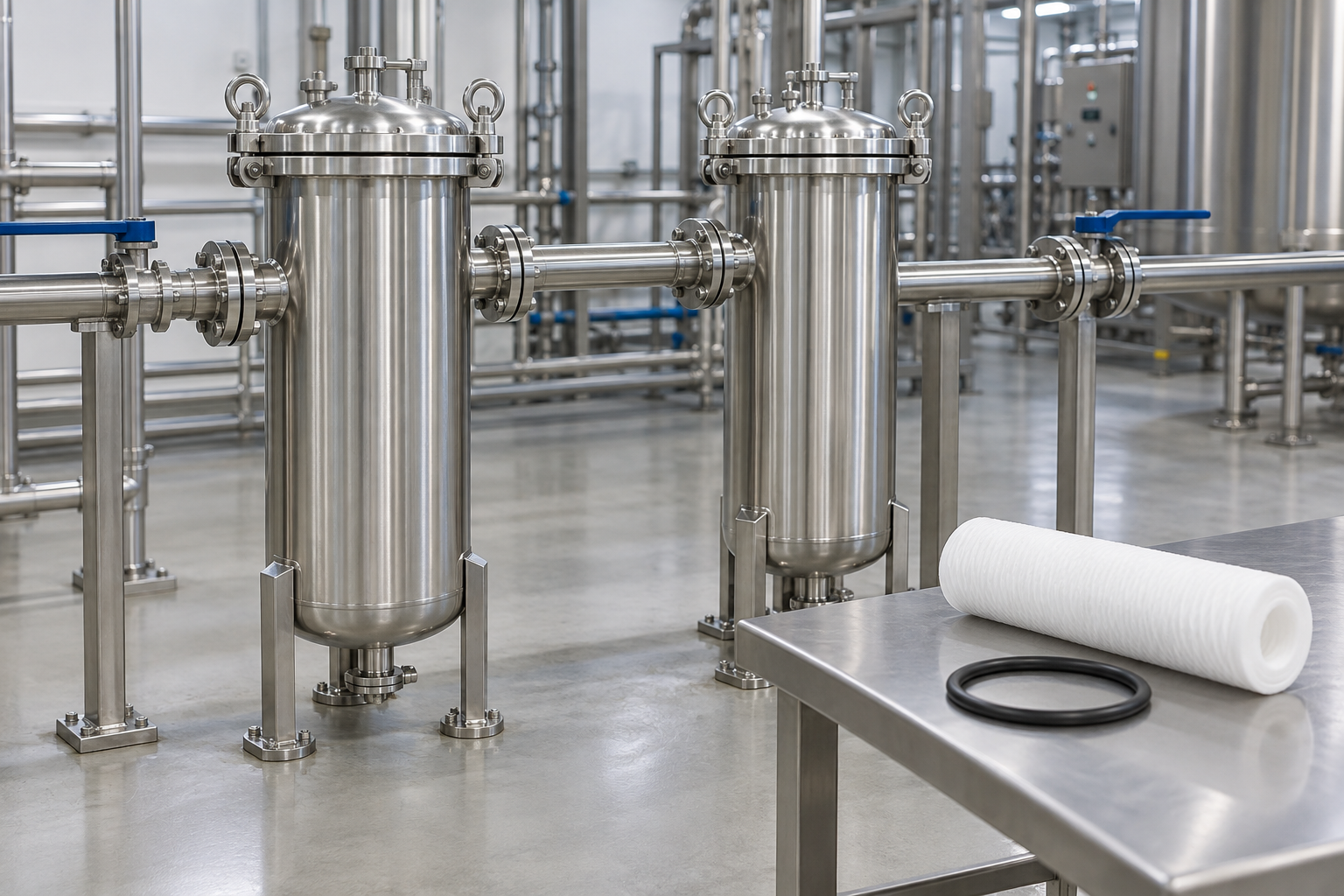
A coarse-to-fine sequence is one common way to divide filtration duties, but it is not a universal design rule. Decide whether two stages are needed by identifying the particles to control, the downstream requirement, expected loading, operating flow and service cost. Adding another housing alone does not guarantee better filtration or longer element life.
Give each stage a defined job
Describe the source and type of particles, how their concentration varies, and the result the process needs. An upstream stage may be evaluated for handling a larger share of the particle load, while a downstream stage may be selected around a specific equipment or product requirement. Define what “coarse” and “fine” mean for the actual media: rating labels from different suppliers may use different test methods or efficiency claims.
If one stage already meets the requirement and particle loading is modest, a second stage may add equipment, pressure loss, floor space and maintenance without a useful process benefit. If the incoming load changes, check that the first stage has enough effective area and an appropriate media construction for the duty; otherwise, it may need frequent service and interrupt the line.
Check the whole system at the intended flow
For each stage, document normal and peak flow, liquid temperature and viscosity, working pressure, filter area, housing materials, seal materials, vent and drain arrangements, and access for element replacement. A series arrangement changes the system resistance, so the responsible designer or equipment team should confirm pump and piping conditions for the combined setup.
Plan the sampling points and measurement method before a trial. To compare what each stage contributes, take samples at the relevant points under comparable operating conditions and record flow, differential pressure, media condition and operating time. The appearance of a final sample by itself usually cannot show whether either stage met its intended target.
Use operating evidence to decide whether to keep both stages
Where the process allows, agree on a trial objective and observation period, then compare the single-stage and staged arrangements using the same measurement basis. Include service intervals, shutdowns, consumable use and any changes in feed quality or pump operation. Record changes in production or cleaning conditions so that a short trial is not mistaken for a general rule.
If the downstream equipment is a membrane system or has a product-quality requirement, confirm its feed-water limits with the system supplier or process owner. Select the stage sequence and rating using the measured duty and the applicable equipment documentation.
For help defining the target particle and rating basis, see our filter-rating selection guide.
Filtration products and inquiries
Shenzhen Guangxiangyu Technology Co., Ltd. supplies single-bag and multi-bag filter housings, precision filters, filter bags and cartridges. For a staged-filtration discussion, share the liquid, particle information, normal and peak flow, pressure, downstream requirement and service history with Liu Nan, Sales Manager, at LiuNan2553@gmail.com. The number of stages and media ratings should be confirmed for the actual process conditions.
See our bag filter housings, precision filters, filter bags and filter cartridges.
Technical reference
Donaldson: Dairy Best Practices Guide. The guide discusses prefiltration ahead of a final membrane filtration step and evaluating filter choice with application-specific analysis; its examples are specific to the applications covered in the guide.